In times of high-return expectations on low investment, economic uncertainty, and new generations rising as consumers, there are only two paths: give up or transform.
In this recap of a talk I gave at the latest ABCasa Fair, I address these pain points and how to use experience as a transformative force for traditional retail.
A quick self-awareness test
Read the following sentence and rate how much you see yourself in it on a scale of 1 to 10. Here we go:
“If you don’t have Attention Deficit Disorder, you’re not paying attention to anything.”
So? 1, 5, 10?!
In this case, the higher the score, the better. The truth, however, is that we need to exercise focus when we’re thinking about solutions, and FOMO the rest of the time. But let’s get down to business. Since this is a recap, I’ll cover the 3 core topics: Immediacy, Ephemerality, and Experience.
Immediacy
We’ve talked a lot about the amount of information available, but what we forget to mention is that among all of it we find terabytes of success stories, comeback stories, get-rich-quick stories; in short, we find every kind of solution to the problems we face every day.
The thing is, these stories generally fail to tell us that the road was long and grueling and the results weren’t immediate, that it cost hours of sleep, headaches, moments of disbelief, and much more. As a result, we learn a little about the problem, a little more about the solution, a lot about the result, and nothing about the complications along the way. This has turned all of us into people who want everything right now. Yes, I said ALL OF US, not just millennials or Gen Z. Sitting here in my Gen X chair, I have to admit I’m no different. In fact, I see this need for immediacy in babies scrolling YouTube on their parents’ smartphones just as much as in baby boomers who never get off Facebook.
We want immediate results so badly that we expect a reward with every interaction, at every moment—what we call Micro-Moments (fig. 1). And all this immediacy also carries over into the moment of purchase, influencing our behaviors and decisions.

This instant reward is what we call Experience.
Ephemerality
To create—or rather, to deliver—this instant reward and provide the best experience, we need to start thinking in terms of moments, and moments are fleeting; they last only an instant or a few.
That’s what ephemeral means: fleeting, something that isn’t permanent. We used to care only about tangible things like form and function—things we could touch and that, in the case of products, we took home and kept with us. Today, however, what people consume are moments, and we need to learn to think about and design moments.
The designer’s job is to create this immediate reward. Designers now think about the experience people will have in that moment, whether in the store or in their interactions with the product or service.
The most valuable asset from a customer’s interaction with my product or space is a memory.
Opening a box, for example, has always been an ephemeral act and, until recently, not a very meaningful one—until someone, Mr. Jobs or Sir Jony Ive, had the idea of turning opening a box into an unforgettable moment, an experience. And so unboxing was born. An ephemeral act that design turned into an experience.
Experience
“Goods and services are no longer enough to foster economic growth” – The Experience Economy, 1988.
To understand what we now call experience, we first need to understand that it’s not a fad or a marketing gimmick, but rather a global economic movement, fueled by the interactions and fast access to information that digital life has given us.
We moved from an agrarian economy to an industrial one, from that to a service economy, and now to what we call The Experience Economy. In it, essentially, agricultural products, manufactured goods, and even services have become major commodities, with prices set by supply and demand and very little added value.
Today, to have value, you need to deliver experience. According to a 2018 Salesforce report, 9 out of 10 Brazilian consumers value the experience over the product or service offered. In other words, the old “my product is good and everyone’s going to buy it” story is over. Today, only 49% of people who walk into a store do so to buy (source: Gensler, 2017), yet retail is still designed only for them—and in doing so, we ignore more than half of the people who walk into our stores.
Failing to understand this is what has caused many stores to lose foot traffic, customers, and sales, and eventually close their doors. From this perspective, the retail apocalypse continues, but only for retailers who ignore the fact that it’s not the times that have changed, but the global economy!
Designers, retailers, marketing directors, and even C-levels need to accept this “new world order” and act accordingly. And to do that, you need to understand what Experience really is.
Experience is not a glorified product or an exalted service, nor is it about entertaining the consumer.
Experience is a planned act in which every moment is precisely designed to achieve the ultimate goal of making something ephemeral, like a store visit, memorable. At Alice Wonders, we work on 4 pillars: Escapism, Esthetics, Education, and Entertainment, all wrapped in plenty of technology that serves to attract and engage, and in the process we collect data mapping shopper behavior. It’s the sum of these 4 pillars that turns moments into experiences.
In the examples below, each pillar is highlighted, but if you analyze them more deeply, you can identify all of them and understand why they’re success stories.
Escapism: Taking customers out of their reality.
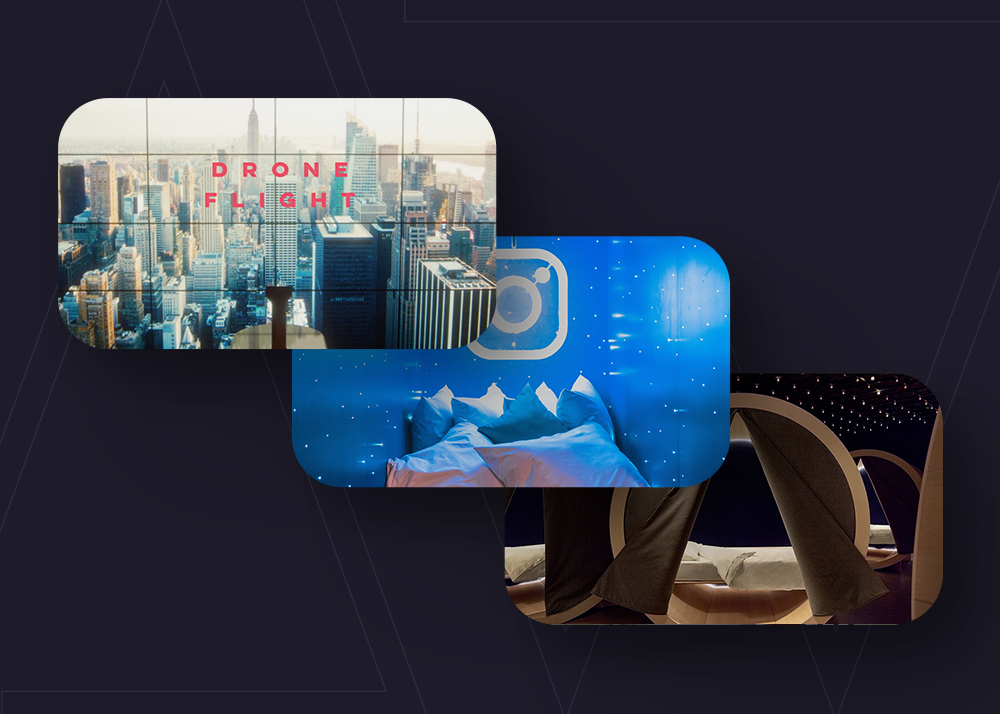
Flagship Casper NY – Customers can book a “nap time” and sleep for half an hour in private pods to test the brand’s mattresses. Pajamas included!

Esthetics: The name says it all, but this is what gave rise to the term “Instagrammable.”

Education: When we teach customers about products or services.
This is a project by Alice Wonders for a real estate launch. To “educate” buyers about the view from each floor and each side of the building, we developed a flight simulator in which customers pilot their own drone.

Entertainment: Anything that distracts and amuses.
In this project, we developed a panoramic elevator simulator to showcase the apartment’s incredible view. A different approach to the same problem.

If you’ve made it this far, it’s because it was worth it. If not, just try to remember this one sentence:
The experience must engage the individual and create a memory.
A sale is just a sale; an experience turns into many sales!
Inscreva-se em nossa Newsletter
Receba no seu email todas as novidades do nosso blog sobre tecnologia e varejo, além de ficar por dentro do novos projetos Alice Wonders.