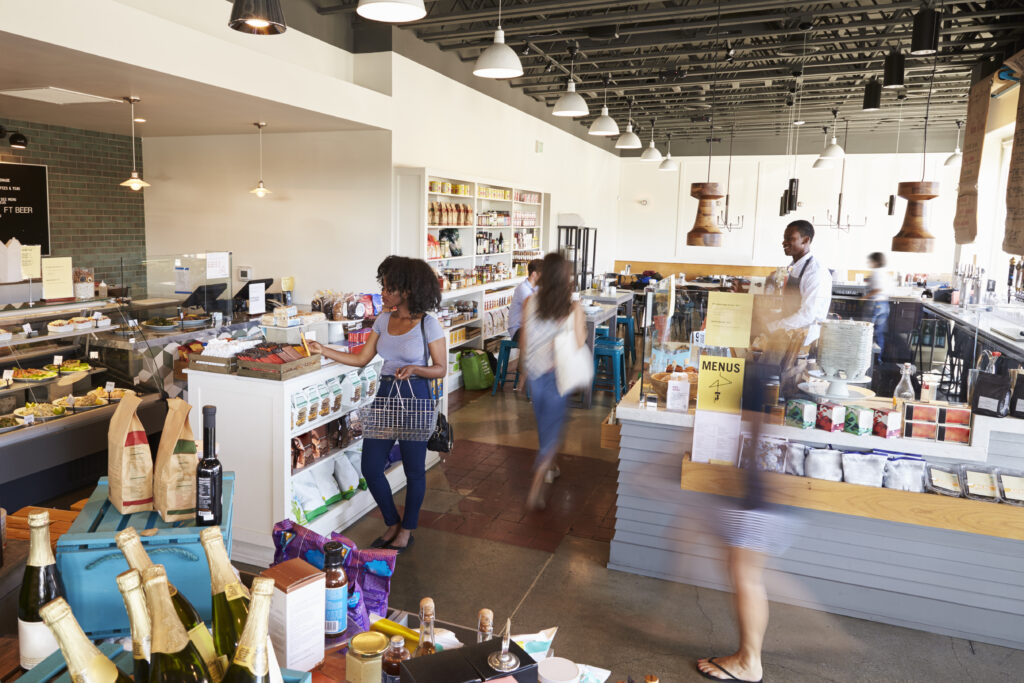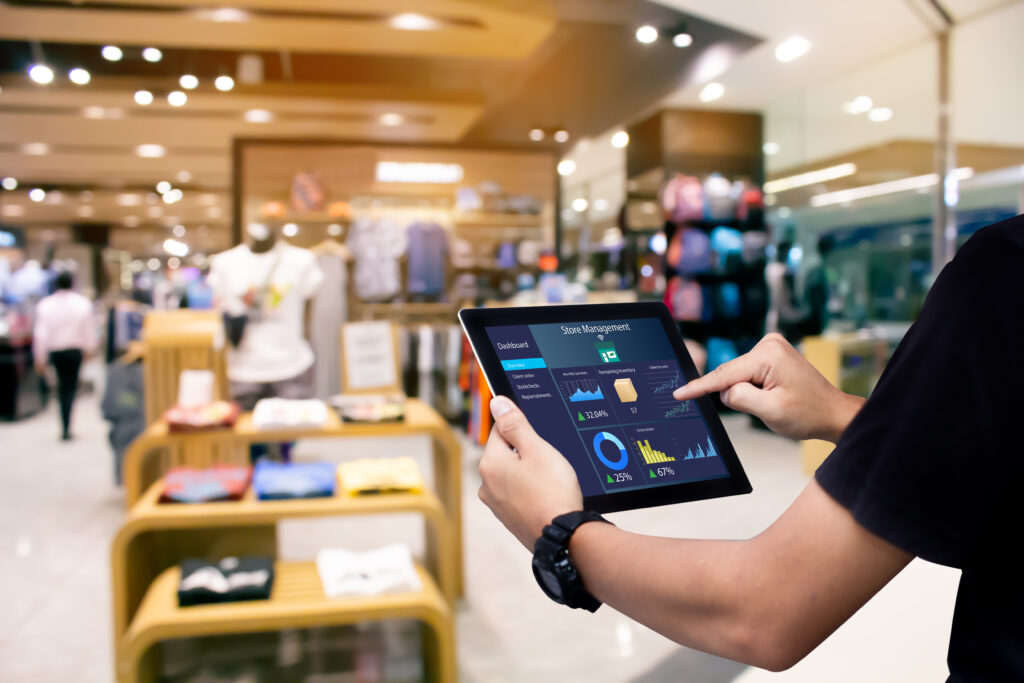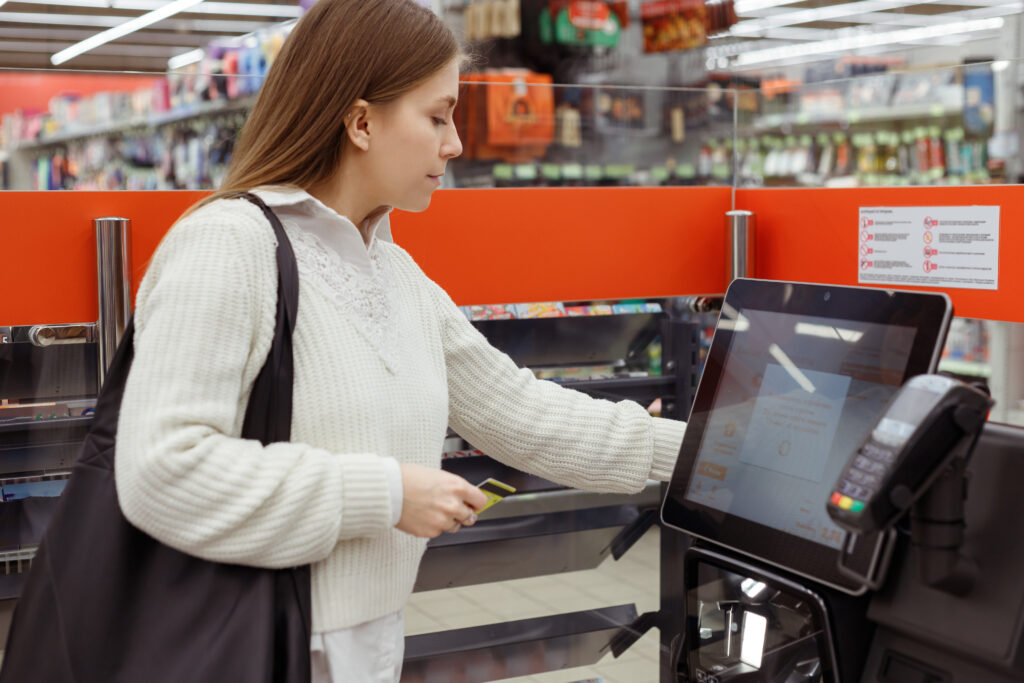
The absence of intermediaries is bringing far more autonomy and speed to the buying process, since there’s no longer any need to hire a sales associate. On top of that, storage costs go down, which benefits both the store and the customer.
We’re talking about self-service, one of today’s biggest retail trends. This business model brings together features of retail and wholesale in a single operation, especially the advantages of each: sales in a retail format, but at wholesale prices. That’s why it’s also known as cash-and-carry.
Want to learn more about how self-service, the retail revolution, works? Then keep reading for more details on the topic!
1. What is self-service?
The most striking feature of this business model is that customers carry out the entire shopping process on their own, including paying for the products.
The format isn’t new, but as consumer behavior has changed, it has been reshaped for the digital age, and that has opened up a sea of possibilities for the retail sector.
Ever since it emerged, around 1912, stores began operating with fixed prices, so that shoppers had to walk around the space to pick out products.
And it was from this retail model that aspects such as the need for packaging, visual identity, POS merchandising, and other elements gradually emerged.
Over the years, the format replaced counter-service retail, which is still used in Brazil and has much higher costs because of all the logistics needed to personalize service.
So another striking feature of self-service is the absence of employees to mediate the buying process, especially when their involvement is unnecessary. The model gradually adapted to larger stores or stores with a wider variety of products.
After the Great Depression, around the 1930s, the format became more popular due to the intense pressure to cut costs and improve efficiency in retail.
2. What are the advantages?
To give you a broader understanding of the subject, we’ll show you the benefits that self-service can offer both customers and retailers.
For the business
It increases team productivity
Shoppers who choose self-service don’t have to wait in line. That means the entire customer service department isn’t overloaded and works with much more “breathing room,” and, as a result, staff can focus on more important cases or on customers who truly need special attention.
It reduces operating costs
Considering that a large share of customers are familiar with self-service technologies and prefer to handle the buying process on their own, the point of sale will see an exponential reduction in the number of employees assigned to customer service.
Lines get shorter, which is directly tied to higher customer satisfaction and an improved experience delivered by the store. Plus, costs go down, which helps the store’s profit margin grow.
It reduces the chance of errors
It’s no coincidence that technology has become an increasingly large part of companies’ day-to-day operations. After all, an automated system is incalculably less likely to make mistakes than a person, right?
This means that the fewer humans involved in the buying process, by removing the intermediary from the equation, the lower the likelihood that something will go wrong.
Just as the Internet of Things once seemed like a complex concept but is becoming more and more common in people’s lives, self-service systems are highly intuitive and only offer the options customers need to scan the products they want to buy and select their preferred payment method.
For the consumer
It shortens the process
How many times have you given up on going to the supermarket, putting it off until you really had to go, when you remembered you’d have to face huge lines?
Well, to give you an idea, lines are considered one of the challenges of retail (we’ll talk more about this later in this article), and one of the advantages of self-service is precisely to minimize or even eliminate this issue, cutting down the time spent on a stage of the purchase that often accounts for the largest share of the entire process.
It improves the shopping experience
You don’t have to be a marketing expert to know that the shopping experience is one of the most important aspects of the entire communication and relationship between a brand and its target audience.
All the effort and investment put into making the POS a more comfortable and welcoming environment for customers share a common goal: to create a memorable moment for shoppers so that they build a bond with the company and become loyal to it.
This involves many aspects of the store, ranging from visual communication elements, such as store colors, product placement, and lighting, to the way staff communicate with the public and the brand’s presence in the market.
Implementing self-service in retail shows that the organization has an innovation mindset and cares about its customers’ well-being, giving them a way to speed up the buying process and make it far more pleasant than in the traditional counter-service retail model.
3. How has self-service worked in other industries?
Although the most problematic part lies in the pre-sale stage, since many customers still aren’t familiar with this type of service, the model has been very successfully applied in other industries.
Among the services that are handed over to consumers themselves, albeit through different forms of self-service, we can mention:
- building your own sandwich: the idea became well known through the Subway chain, but many other companies have adopted it;
- pumping your own gas: this has worked very well for decades in European countries and in the US;
- checking in at hotels and airports: apps and services for buying plane tickets or making reservations are increasingly common;
- buying movie tickets: the same applies to concerts, theater, and other cultural events;
- doing banking transactions: online banking has eliminated many barriers and bureaucratic hassles that intermediaries used to cause in the process;
- researching a product’s origin in a store: today, any consumer with a smartphone and internet access can check other customers’ reviews and base their purchase decision on information they researched themselves.
4. How does it affect consumer behavior?
As you may have already noticed, in the self-service model, instead of simply reaching out to a store employee, customers can solve their problems on their own, which makes the process much faster and creates a win-win for everyone involved.
In that sense, we can say that self-service draws inspiration from one of the features users find most appealing in the digital world: the autonomy to solve their own problems.
On an e-commerce site, for example, there is always an FAQ section. There, users can get their questions answered on their own or choose to reach out through one of the available customer service channels.
The consumer tends to trust the store, knowing that the brand isn’t trying to interfere with their purchasing decisions, since it’s natural for people to shut down when they feel they’re about to fall for a “sales pitch.”
Although many retailers no longer follow this outdated model in which sales associates are required to approach consumers aggressively, pushing any product just to close the sale, it’s a stigma that retail will continue to carry for a few more years.
That said, one of the advantages of self-service retail is that it breaks down this barrier of consumer distrust, giving shoppers the power to move through the buying process at their own pace and in the way they want.
This helps increase customer satisfaction and, as a result, boosts customer loyalty to your brand.
5. How to apply self-service at the POS?
One of the first steps to implementing self-service efficiently at the point of sale is to start with how merchandise is organized, since POS merchandising strategies, such as proper product display, are among the factors that influence the shopper’s purchasing decisions.
Another important point to consider is product placement. A well-organized, properly signposted sales floor gives consumers the information they need, which will serve as support and make the shopping experience much more positive.
The sense of autonomy and freedom, in turn, empowers customers, making them feel in charge of their own purchasing decisions rather than the target of an intrusive marketing strategy.
However, for this to work in practice, the POS needs to be adjusted to meet consumer expectations so that, whatever the product choice or consumer profile, their experiences with both the store and the self-service option are positive.
What we mean is that it’s not enough to scatter self-checkout kiosks around the store and leave your customers to fend for themselves.
A well-structured self-service implementation strategy requires communication materials with useful information for customers, whether to promote products or to explain how to use the equipment through which self-service is carried out, such as:
- brochures;
- posters;
- cross-merchandising;
- bundled purchase suggestions.
And even a few employees to assist consumers who run into difficulties operating the self-checkout kiosks.
6. What are the challenges?
Now that you have a broader idea of what self-service is and how this innovative alternative should work, we’ll show you the main reasons why this sales format still struggles to be implemented in our country.
Lack of investment
Implementing self-service still faces one problem in our country: retailers’ lack of investment in customer service.
To give you an idea, in 2015, adding up the losses of several brands, Brazilian retail lost around US$217 billion due to consumers who switched to competitors, claiming they had a negative shopping experience with the original brand.
Considering that the purpose of self-service is to eliminate intermediate steps and empower customers by giving them autonomy, failing to invest the resources needed for this business model to work properly means wasting the company’s time and money, not to mention hurting its credibility with consumers in the market.
Difficulty handling high demand
Another challenge to successfully implementing this model in Brazil is the difficulty of handling high market demand.
The fact is that Brazilian consumers have grown used to depending on intermediaries in their buying process, yet at the same time they’ve been spoiled by the immediacy the digital age has provided.
Even when it comes to solving simple, quick issues, today’s customers want to be served quickly, but with all the support traditional retail can provide.
In other words, they want service that is fast and supported. The big problem is that most retailers aren’t prepared to handle this kind of demand, especially those that don’t invest enough to make their customer service flawless.
The result ends up being the opposite effect: high demand and little support, making customer wait times much longer and, of course, the self-service model unsustainable.
Poorly defined processes
The natural trend is that, over time, consumers will learn to use self-checkout kiosks and enjoy the experience of speeding up their shopping, just as the service works in European countries and the US.
If we stop to think about it, it’s not much different from the evolution of cell phones into smartphones in Brazil. At first, it didn’t seem like those little pocket computers would catch on with the public, precisely because they seemed like complicated devices for the general public to understand, but within just a few years, we now have more than one active smartphone per capita.
What we mean is that, despite challenges such as poorly defined processes, it’s still far too early to say that this innovative, efficient and cost-effective autonomous shopping model won’t thrive.
Lines and lack of consumer knowledge
While modern organizations today are seeking to create positive consumer experiences starting at the POS, making it easier to choose merchandise, the same can’t be said about lines. That’s because it’s necessary to implement systems that respond to demand, which, in turn, is growing more intensely and with less patience.
Think of bank ATMs. The idea was to create a solution to reduce wait times, especially for those who didn’t want to go into the bank and stand in line, but we know the reality is quite different. Unfortunately, it’s not much different when it comes to self-service. The purpose of the service changes, but it works in a similar way.
In this respect, there are two distinct but connected problems hindering the implementation of self-service in retail. On one hand, there’s high demand, which naturally causes lines to form, something this business model aims to solve.
On the other, a large share of the actively consuming population is still highly dependent on traditional retail formats and runs into major obstacles when facing the screen of any kind of self-service kiosk.
We see a certain eagerness among consumers to become digitally included, but a vast gap of exclusion and lack of access to information separates them from the reality that retail is building together with technology.
7. What precautions should companies take when implementing self-service?
We’ve covered the many benefits that an autonomy-based sales model has to offer, as well as some of the challenges self-service still has to overcome in Brazil before it can be effectively implemented in retail.
That’s why, before we wrap up, it’s important to look at a few precautions stores should take when adopting this business model. After all, self-service should work as a two-way exchange in which both customers and the store come out ahead, right?
Give customers detailed information
A big mistake when implementing self-service solutions in your business is failing to provide shoppers with detailed information about your products or services.
Even if there are staff members on hand to answer questions, that’s not the point of self-service, is it?
Don’t let service lose its “human” side
It’s important not to confuse optimization with automation for its own sake. When self-service isn’t well managed, a store can end up streamlining the shopping experience so much that the brand gradually loses its human connection with customers.
That’s why, even after successfully implementing POS technology, it’s essential for the company to keep employees on hand to assist shoppers who prefer to talk to a person.
Understand and educate your customers
As tech-savvy as the consumer 4.0 may be, keep in mind that there are still plenty of customers who may push back on something new. Depending on where the store is located, this group of shoppers can be quite significant.
So the first tip is to get to know your target audience well: understand their pain points, how your store can meet their needs and, of course, their limitations when it comes to using technology as a solution.
If you decide to invest in self-service solutions, do it gradually. Instead of replacing all your checkouts at once, roll out just a few machines and keep employees nearby. Remember that you can also run campaigns and initiatives to help customers get comfortable with the change.
Integrate multiple payment methods
Having self-service kiosks isn’t enough. It’s important to offer your customers a range of payment options, such as debit, mobile, credit and direct debit, and integrate them into your sales system so the overall experience is as positive as possible.
Use a user-friendly system
Just as visual identity has the power to shape how customers see a brand, to the point of influencing their purchasing decisions, the same goes for the interface of a self-service system.
If it looks complicated or, even worse, fails to make shoppers feel secure, with confusing and poorly laid-out information, hardly anyone will choose that option. After all, people need to find an intuitive solution, not one more problem to deal with at the point of sale.
Pay attention to POS communication
Your entire merchandising and POS communication strategy must be built in alignment. In other words, signage with incorrect information can jeopardize your whole self-service rollout.
Put yourself in the shoes of a customer who is already skeptical and somewhat resistant to this new approach. If they run into surprises when scanning a product and notice, for example, that the advertised price differs from the one in the system, their negative opinion on the subject is unlikely to change.
As you’ve seen in this article, self-service isn’t just a retail trend, but an imminent reality driven by changes in consumer behavior, which are becoming more and more frequent thanks to technological advances and the widespread adoption of the internet.
The new generation of consumers enjoys engaging with technology and being in control of their own purchasing choices. So considering self-service isn’t about looking toward a distant future, but toward something that is very close to becoming part of the present.
Do you still have questions about how self-service represents a true revolution in retail? Want to find out how we can help? Then get in touch to learn more!
Inscreva-se em nossa Newsletter
Receba no seu email todas as novidades do nosso blog sobre tecnologia e varejo, além de ficar por dentro do novos projetos Alice Wonders.
Thank you for subscribing.
Something went wrong.
Respeitamos sua privacidade e levamos a sério a sua proteção