For a long time, experience took a back seat when it came to competitive advantage. Many brands competed on what was easiest to measure: price, product, features, reach, and technology.
Today, those elements still matter. But they are less and less enough to guarantee differentiation.
The real battle is happening somewhere else: in the ability to create experiences that are relevant, Technology has become more accessible. Artificial intelligence has accelerated creation and personalization processes. Products, services, and features can be replicated faster than ever. And in a landscape of information overload, capturing someone’s attention is only the first challenge.
The real battle is happening somewhere else: in the ability to create experiences that are relevant, meaningful, and memorable.
When different brands can offer similar products, technologies, and features, the way a company makes people feel can become a competitive advantage that is hard to replicate.
That’s why, today, experience is no longer just an add-on. It now plays a strategic role in creating value for both brands and consumers.
The challenge of competitive advantage in retail
Consumers have never had so many options. They can compare prices in seconds, find alternatives for virtually any product, and access similar experiences across different brands.
Technology, which once served as a major competitive advantage, has also become more democratic.
An artificial intelligence tool, an interactive screen, or an immersive experience, for example, is no longer necessarily new in and of itself. The result is a landscape in which many brands can offer similar kinds of products, technology, or interaction.
Which raises an important question:
What makes a person choose, remember, and connect with a brand when so many others can offer something similar?
The answer lies in experience.
When we talk about brand experiences, it’s common to think of technology right away:
- Projections;
- Augmented reality;
- Artificial intelligence;
- Sensors;
- Interactive screens;
- Immersive environments.
All of these resources can transform the way a person interacts with a brand. But technology alone doesn’t create a relevant experience.
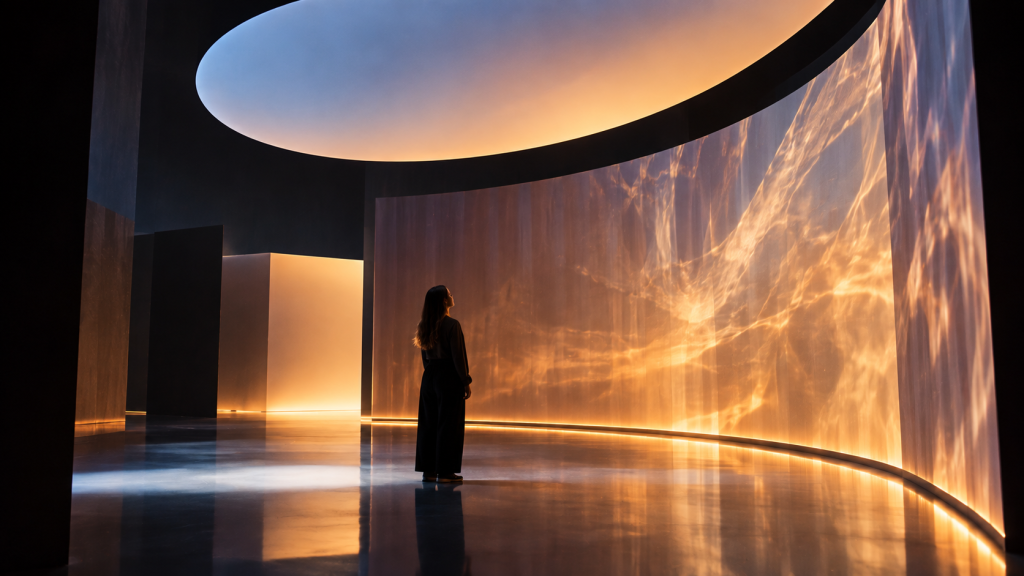
A screen can grab attention. A projection can surprise. An installation can generate shares.
But a truly powerful experience needs a purpose.
It must address a brand need and, above all, make sense to the people living that moment.
How do you turn experience into a competitive advantage?
Creating relevant experiences doesn’t simply mean adding more technology to touchpoints. It means starting with strategy.
That’s why we’ve put together some best practices for turning experience into a competitive advantage.
1. Understand what the brand wants to evoke
Before choosing a technology or designing an installation, you need to understand what perception the
Before choosing a technology or designing an installation, you need to understand what perception the brand wants to build.
Do you want to spark delight? Curiosity? Belonging? Discovery? Trust?
The desired emotion helps guide the entire experience and ensures that every element has a role within the journey.
2. Understand how people behave
An experience is only relevant when it speaks to the people on the other side.
That’s why understanding habits, expectations, needs, and behaviors is essential to creating interactions that make sense — rather than experiences that merely grab attention.
The better a brand knows its audience, the better it can build relevant, personalized experiences.
3. Use technology with purpose
Technology should solve a problem or amplify an idea.
It can make content more interactive, create new ways to participate, personalize a journey, or turn a space into a dynamic experience.
But there’s one key point: technology needs to serve a bigger narrative.
It’s this combination of strategy, creativity, and technology that turns a tech feature into a meaningful experience.
4. Create something people want to experience
The experience needs to invite participation.
The more the audience goes from being mere spectators to becoming part of the experience, the greater the potential for connecting with the brand.
The goal isn’t just to create something that’s seen, but something that’s lived, remembered, and shared.
5. Think beyond the moment
An experience doesn’t end when the person leaves the space.
It can live on in conversations, on social media, in photos, in memories, and in the way that person comes to see the brand.
That’s why experiences need to be designed as part of a journey — not as isolated activations.
This perspective expands the potential of experience as a competitive advantage, connecting the physical moment to the brand’s other touchpoints.
Experience as a competitive advantage
In an increasingly competitive market, simply offering something new may not be enough.
The real advantage lies in the ability to create something relevant for people.
Experience can turn a product into a story, a space into a point of connection, and an interaction into a memory.
And that takes more than technology. It takes understanding the audience, setting clear goals, and building a cohesive journey between brand, space, and people.
Recent research reinforces this shift. PwC points out that price and quality are increasingly becoming baseline requirements, while personalized, meaningful experiences are gaining importance in building value and loyalty.
That’s why thinking of experience as a competitive advantage doesn’t mean abandoning product, price, or technology. It means connecting those elements to something bigger: an experience with purpose.
Turn technology into experience with Alice Wonders
At Alice Wonders, we believe technology only makes sense when there’s a story to tell, a connection to create, and an experience to build.
That’s why we develop experiences that combine strategy, creativity, technology, and design to turn physical spaces into points of connection between brands and people.
From concept to execution, we create experiences designed to generate more than interaction: we want to create moments that spark emotions, build connections, and stay in people’s memories.
Because in a market where technology is becoming more and more accessible, the real competitive advantage lies in knowing what to do with it.
Is your brand ready to stop just being seen and start being experienced?
Get to know Alice Wonders and discover how to turn technology into experiences that make sense — and make people remember.
Inscreva-se em nossa Newsletter
Receba no seu email todas as novidades do nosso blog sobre tecnologia e varejo, além de ficar por dentro do novos projetos Alice Wonders.
Thank you for subscribing.
Something went wrong.
Respeitamos sua privacidade e levamos a sério a sua proteção