




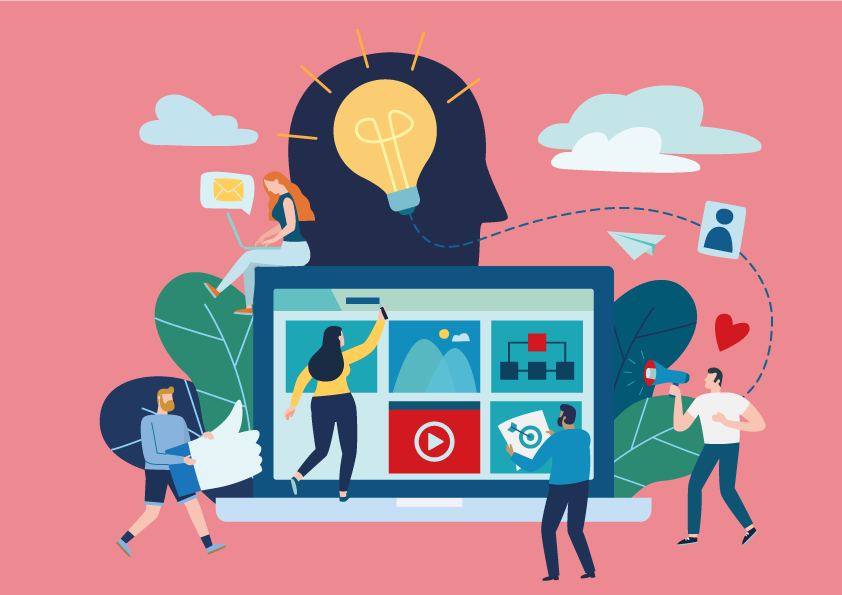
The retail market is growing more competitive by the day, and winning over consumers is no easy task. It’s fair to say that a brand’s customers are no longer just an audience for the content it produces. Today, communication between a brand and its audience is a two-way street: consumers interact, send messages, and answer questions, becoming more active throughout the entire purchasing process.
This shift in customer relationships has been a challenge for many companies that still don’t grasp the power of Brand Experience or don’t even understand how the concept applies as a whole.
With that in mind, this post explains what Brand Experience is and why it matters for a brand, and shows how it can be applied across the physical and digital channels a company uses (separately or in tandem). All so you can learn more about the subject and reflect on why it’s a decisive factor in your brand’s survival in today’s market. Read on!
What Brand Experience is
Although many people think of Brand Experience as a tool, it’s actually a marketing strategy aimed at adding more value to a brand’s image. This strategy uses sensory stimuli at brand touchpoints to evoke unique emotions, experiences, and feelings in consumers.
These sensory stimuli can be applied to the following aspects of a company:
Visual identity
It should match the brand’s consumer profile. For example, products aimed at a young audience should come across as laid-back, communicating with customers in a spontaneous, casual way. Even the POS design should convey the brand’s identity and influence the purchase decision.
Concept
Like visual identity, the concept should relate to the target audience. A brand’s concept is one of the elements that allow customers to identify with what it offers. It’s important to communicate the company’s values and commitments to the public in order to build trust. This is a fundamental move in a Brand Experience strategy.
Human-centered service
This type of customer service seeks to build a relationship with customers that goes beyond the simple act of serving them. It ensures greater consumer satisfaction and builds a longer-lasting relationship — while also making service faster and more efficient;
Innovative promise
The brand should create straightforward propositions that deliver a product or service that makes consumers’ everyday lives easier.
Other elements can also make the consumer experience unique and memorable, such as the way the company communicates on social media, impactful marketing campaigns and activations, and even the design of its products.
Brand Experience often involves activations that let the public evaluate and try out a brand before deciding to buy the product or service. That way, they can be sure the product truly meets their needs.
Brand Experience activations generate insights and the ability to predict customer behavior, improving the consumption flow. On top of that, the brand conveys its identity to the public, makes its communication with them more direct, and drives greater brand engagement.
How to implement Brand Experience
For Brand Experience to succeed, synergy is essential. This means every step must be carefully planned across the company so that everyone who interacts with consumers in any way is prepared and able to make a positive impression on them.
For example, if a company’s sales team has been well trained and serves customers masterfully when they buy a product or service, but technical support falls short in some or all respects, the customer will come away with a negative impression of the brand, regardless of their experience with the sales team.
This shows that building a good consumer experience is highly complex and requires time and investment — though not necessarily a large one. On the other hand, destroying a brand’s reputation is all too easy, and it can take years to restore its image and market recognition.
Another very important strategy to consider when it comes to Brand Experience is Live Marketing, in which activations at the touchpoint create sensory experiences that stick in the consumer’s mind as something special, exclusive, personalized — “made for me.”
Live Marketing is also known as promotional marketing, and it reinvents itself almost daily, focusing on the interactions between the public and the brand, which is why it’s directly tied to Brand Experience.
In this context of delivering unique experiences to consumers and conveying the brand’s message, selling the company’s products and services becomes secondary. That’s because Brand Experience aims to touch people’s souls, leaving a legacy that speaks to the consumer’s personal values.
American author Chris Anderson coined the concept of the “long tail,” which made it possible to understand that there are many audience niches, each with its own types and specifics — a challenge for anyone planning Brand Experience. After all, each type of audience relates to the brand differently.
This theory compares the market to an animal’s long tail, like a dinosaur’s. The comparison stems from the fact that the tail is always thicker at the base and tapers toward the tip, just like the market, which has very broad audiences alongside extremely fragmented ones that may buy very specific products or services.
Understanding these differences within a company’s audience is crucial for anyone working on Brand Experience strategies.
Summing up the benefits and results
The outcomes of implementing Brand Experience revolve mainly around the experience consumers have with your brand and how it benefits the brand. Below are the benefits and results of Brand Experience:
It earns customer loyalty
When the consumer experience is positive, it creates a unique feeling of affection for the brand. This is the main feeling a company investing in Brand Experience aims to spark in customers, because it is what makes them become loyal to the brand.
What’s more, when consumers have a distinctive experience in their relationship with a company, they instinctively want to share that discovery with friends, family, and even online, potentially bringing thousands or even millions of people to do business with your brand.
It increases the value of your products or services
Building a strong, reputable brand is the right path to adding value to the products or services you offer. When Brand Experience strategies are well planned and executed, the chances of the company becoming a benchmark in its industry are very high.
The differentiators it offers, such as innovation, functionality, and above all unique sensations, put the brand ahead of its market competitors, allowing it to charge higher prices — while still keeping them fair.
Easier sales
Brand Experience strategies make the sales process easier because they spark the consumer’s desire to buy. When contact with the brand is positive before the purchase, the customer’s decision becomes much easier, since there’s no need to convince the consumer of the quality of the product or service.
It increases the company’s market value
Premium brands tend to have a higher market value, which helps attract more investors to the company. Attracting new investors is tied to Brand Equity, a set of unique characteristics that give a brand its value.
Many other factors affect the numbers, and of course this concept isn’t the only one tied to a company’s market value. Even so, a well-known brand with loyal customers can be a very significant asset for the company.
It improves communication and customer relationships
Since effective communication and exceptional service are part of Brand Experience strategies, they help the company gain insights into its relationship with customers and their relationship with its products and services. This also lets the company measure customer satisfaction, a metric that is crucial for its growth.
The digital experience
The digital space is very important for Brand Experience, because it delivers experiences that build a clear brand image and a real connection with the audience. A digital brand experience can only succeed when it’s tied to a clear strategy.
Digital Brand Experience strategies aren’t used to pressure consumers into buying, but rather to move them toward a predetermined company goal while fostering positive feelings about the brand. That way, the consumer will think of a favorite brand first when they eventually want to buy something specific.
A great example of a brand that shapes brand mindset before the sale is Nike Plus. The platform doesn’t sell shoes; it sells ideas, concepts and a lifestyle. Consumers are drawn in very naturally because the brand understands their profile. So when they think about making a purchase, they’ll easily think of Nike because of the engaging, relevant experiences they’ve had.
Another case of innovation in customer relationships through digital experiences was when Samsung created a highly unconventional store in New York. Using different products and technologies, Samsung showed how to deliver a unique experience to consumers.
Nothing is sold in this store, because it’s a Brand Experience strategy designed to draw the public to the brand’s value of innovation. This is done through exclusive art installations showcasing trends like IoT (Internet of Things) and virtual reality.
Beyond these examples, it’s also important to talk about how the modern consumer’s lifestyle demands being able to interact with the brand anytime, anywhere. That’s why it’s important to invest in brand mobility to enhance the audience’s mobile experience.
Finally, the last thing you need to understand about the digital experience is that the relationship with consumers is judged mainly by your presence and engagement on social media and online communities. These tools can be put to great use to convey the brand image and build relationships with consumers.
The physical experience
The retail POS is where the physical experience with the consumer happens. Whether through authentic store design, lighting, themed sounds, background music or the scent the space gives off — smell is the sense best able to convey emotions to the brain — consumers are able to build a positive experience of the brand.
The sensory stimuli experienced by the audience combine with an interactive experience strategically used by the brand at the POS, letting consumers have their first contact with the product on offer and try it out in an unusual and surprising way.
But it’s not enough to simply make the product available through an interaction with the product or service; this process needs follow-through from start to finish. Consumers can’t feel abandoned by the brand, so planning also needs to account for the continuity of this relationship.
The starting point of the physical experience in Brand Experience is, in addition to using creative and innovative strategies, adding knowledge, feelings and intelligence for the consumer (and it doesn’t have to be limited to the POS). And nothing does that better than a fun, different interaction like the one Electrolux offered the public at the 25th São Paulo International Motor Show to promote its pressure washers and vacuum cleaners.
At this event, an experiential space and booths were set up to welcome guests and potential customers. First, visitors were invited to get the cars dirty while having fun with paintball guns, creating a sense of freedom and accomplishment — paintball was something new for many of those there.
After getting the cars as dirty as they liked, visitors could try out the pressure washers to clean them. Then they were invited to another activity, where they could dirty seats and carpets and then test the vacuum cleaners on display at the event. At the end, they could also enter to win pressure washers and vacuum cleaners.
Melissa stores also tap into the consumer’s physical experience, but in their case it happens at the POS. With its signature bubblegum scent, the brand stands out from the other stores in the mall even from a distance and makes its scent and name stick in the customer’s mind. From there, the brand built a true culture around its product — so much so that the secret, nostalgic bubblegum fragrance was given away at all of the brand’s stores in Brazil on Customer Day.
Interesting, right? Activations like these, where consumers interact with the brand and the product instead of just seeing it on a shelf without being able to try it, have become an irreversible trend. They don’t need to be grand — they just need to be unexpected and enjoyable.
Why aligning both experiences matters for Brand Experience
Modern consumers blend the physical and digital worlds so seamlessly that they can’t understand why a company wouldn’t do the same in its sales processes, customer service, and so on — whether it’s an e-commerce company without a physical store or a brick-and-mortar store that still hasn’t established an online presence.
So when the store and the online operations are kept separate, transactions tend to be complicated when they could be simple.
This disconnect between physical and online creates negative experiences for consumers, such as dissatisfaction and a lack of trust. Bringing the two together isn’t as hard as it may seem, yet some companies are still reluctant to invest part of their resources in digital capabilities. And worse: when they do, they usually run their physical and digital operations separately. Can you believe it?
This habit hurts both sides, because these companies choose to manage the two channels for reaching consumers in whatever way is most convenient for them, not in the way that’s most effective for the business — and customers don’t expect to use them that way.
What they don’t realize is that phygital innovations don’t just change the products and services on offer; they also make it possible to identify tools that strengthen the core business and create new revenue streams.
To align the two experiences, every aspect of the customer experience must be thought through systematically, developing innovative elements that engage consumers, increase competitive advantage in the market, and accelerate growth.
Oakley, the famous eyewear brand, is a great example of merging physical and digital experiences in retail. At an edition of the Ironman event held in Florianópolis, attendees had the chance to try on virtual reality headsets and step into an environment where they could understand, hands-on, the benefits of the different lens technologies.
At the same time, the entire e-commerce structure was adapted for in-person sales at the event, leveraging all the efficient technology already in place online for the offline environment.
The result was a deeper, more impactful product experience for hundreds of people at the event, capturing the attention of both those who already knew the Oakley brand and potential new customers.
Finally, keep in mind that when aligning physical and digital channels, the main challenge isn’t consumer skepticism about your products and services, but rather a lack of experience in executing it.
The effects of aligned Brand Experience
Aligning the digital experience with the physical experience is the best way to please the modern consumer, who likes being connected and having online experiences but also values physical contact with the product and with people.
The digital transformation that has taken place in retail is the result of the innovations needed to adapt to the consumer’s new lifestyle, and aligned Brand Experience is one of the elements of that transformation.
Some of the results you can achieve by aligning the consumer’s digital and physical experience are described in the list below. Check it out:
- improves POS visibility through attractive, innovative technologies;
- highlights the quality of product and service presentation;
- ensures accurate information about the product or service is conveyed;
- boosts store productivity by giving consumers more autonomy;
- expands the brand’s reach thanks to aligned initiatives, bringing traffic to POS locations that weren’t being visited before;
- strengthens the relationship with consumers, who will feel recognized;
- fuels word-of-mouth marketing, since it delivers aligned online and offline experiences — exactly what modern consumers want and would never fail to tell others about;
- increases sales, both from customers already loyal to the brand and from those drawn in by the strategies used or who visit your store on someone’s recommendation.
As we’ve seen, Brand Experience strategies are highly relevant when companies want to stand out in the market and attract more customers. Modern consumers are increasingly connected and demanding, while still appreciating good personal contact with the brand.
Exploring consumers’ physical and digital experiences in retail benefits both the brand and the potential customer, and when these experiences are aligned, they can transform the relationship between them.
Enjoyed our guide to Brand Experience? Then be sure to follow us on social media so you don’t miss any updates from our blog! You can find us on Facebook, Linkedin, YouTube, Instagram, and Vimeo!
Inscreva-se em nossa Newsletter
Receba no seu email todas as novidades do nosso blog sobre tecnologia e varejo, além de ficar por dentro do novos projetos Alice Wonders.
Thank you for subscribing.
Something went wrong.
Respeitamos sua privacidade e levamos a sério a sua proteção






