




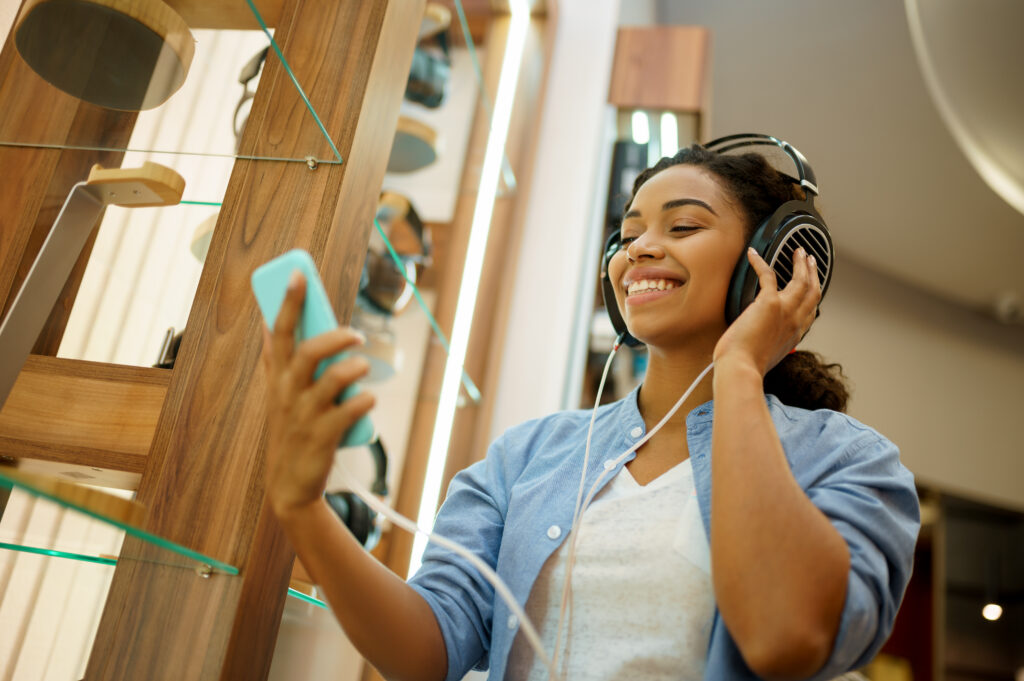
The experience a customer has at the point of sale is the most important factor in turning them into a loyal customer. Buying behavior is how a group of people, or an individual, chooses what they want to buy or which store they intend to visit.
Behavior is shaped by our experiences and stays with us throughout our lives.
Environmental, economic, technological, political, and cultural factors are some of the reasons that drive changes in buying behavior, but there are things every successful brand can do at the POS to positively influence the purchase decision.
Today we’re going to talk about music, an environmental factor that can make shopping more enjoyable for your customers.
How does music influence the point of sale?
The background music we hear in malls and supermarkets isn’t there just because the owner or the employees like it. Although there are still places that play songs with no ulterior motive (such as neighborhood shops and small markets that don’t face strong competition in their area), most companies use music as a strategy.
You need to think carefully when choosing what to play. Music in retail spaces can do as much harm as good. Sounds can make your customers fall in love with your store and buy more, because they feel good in that environment. But they can also trigger a visceral reaction in people who hate a particular genre or feel overexposed to a certain band.
Even taking into account those who don’t like hearing music at the point of sale, companies that choose to play it still see plenty of positive results. Check out some studies published by Business Insider that explain how and why music drives sales in retail.
Music should suit the target audience
Areni & Kim, two behavioral researchers, discovered in 1993 something that should seem obvious to us: companies that choose the right music to promote their products to customers are more successful.
That’s why, over the course of their study, they found that playing classical music to boost sales in wine stores works better than playing the top pop hits on the Billboard charts. Using music by composers like Beethoven and Chopin also has another big benefit: it increases the average ticket. Customers shopping with these soundtracks in the background felt more inclined to buy higher-priced bottles of wine.
Restaurants that play classical music also sell more than those with no soundtrack at all. The only “catch” the research found was that this type of music can drive away customers who associate it with a high-income crowd.
Music tells us what to buy
Also focusing on wine retailers, researchers North, Hargreaves & McKendrick discovered that music can influence exactly which products shoppers pick off the shelves. People who hear French songs are more likely to buy wines from France, and the same goes for Italian, Spanish, and German music.
Interestingly, the same study also shows us why hold music on customer service lines is so popular. Ever since it started being used, many brands have noticed they could keep customers on the line longer.
Different tempos trigger different reactions
Lighter music, like the kind played in the background of lounges and spas, also delivers incredible results in retail.
That’s because it makes shoppers linger and buy more. According to experts Milliman, Caldwell & Hibbert, calmer music gives us the perception that we haven’t spent that much time in the store.
Faster songs, on the other hand, work better for certain types of businesses, such as supermarkets. The faster, livelier, and more upbeat these soundtracks are, the more quickly customers move through the store, but this won’t lower the average ticket. It simply means more people get served.
How do you put together a soundtrack for your store?
Now that you know the effects of music on retail performance, you’re probably wondering how to benefit from it too. A store that plays music should, first of all:
Choose music based on a strategy
Without defining what music will do for your business, it’s very hard to build an in-store radio station. So the first question you need to ask is: what do I want to achieve with this soundtrack?
Whether you need customers to spend more time in your store, buy more, or simply have a comfortable shopping experience, you need to pin that down first in order to decide whether music will be able to influence buying behavior.
Get to know your target audience better
The people who make up your target audience are very much alike. They all share an interest in the products you sell, like buying them at your store, and are likely to do so again, needing only a little nudge.
There’s much more they have in common that you don’t know about. Your personas may be fans of the same band and frequent other similar places.
It’s these shared traits that set your audience apart, and market research will help you understand what to play on your in-store radio.
Research which genres deliver the best results
The themes of the songs are also very important if you want to use them in your store. The lyrics and rhythms should not only appeal to your target audience but also make you and your employees feel comfortable with what you’re hearing.
Run tests and find out which songs both boost your team’s performance and achieve your strategy’s goals.
Hire a team that specializes in experiences
Companies that develop experiences are there to make your project a success. They can create customized, automated radio for your point of sale, or design an immersive strategy in which music isn’t the only factor encouraging your customers to buy more.
Consider partnering with these companies to get better results.
What’s the challenge in using music to influence buying behavior?
Plenty of stores play music constantly, and it has no impact on their revenue at the end of the month. That’s because there’s a major challenge in implementing this strategy.
Music is perceived through the senses and in a unique way by each listener. This means it may not convey the message we want. A song that feels super upbeat to you may be irritating to a customer.
Trial and error will help. Monitor how the music is received by shoppers and see whether it’s truly enhancing the shopping experience.
The same type of music can work across several segments, and the fact that a genre is heard more often in malls than in street-front stores isn’t reason enough to rule it out. If you invest in music to influence consumer behavior in your segment, there’s a good chance your store will pull ahead and be more successful than the competition.
Music isn’t the only factor that influences buying behavior. Find out how interactivity can be used to create a POS that sells more!
Inscreva-se em nossa Newsletter
Receba no seu email todas as novidades do nosso blog sobre tecnologia e varejo, além de ficar por dentro do novos projetos Alice Wonders.
Thank you for subscribing.
Something went wrong.
Respeitamos sua privacidade e levamos a sério a sua proteção






