




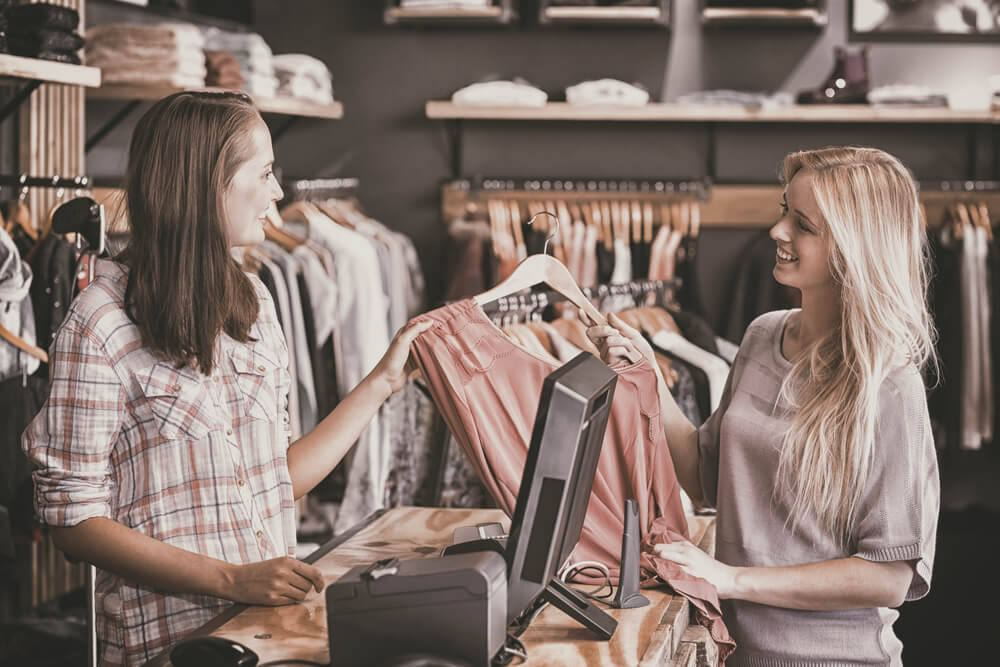
Even if your store offers quality merchandise and your customers always find what they’re looking for, presenting your products in a more attractive way is a great strategy to spark interest and encourage the purchase of other items. That’s why not just your window displays, but your store design as a whole, should be planned with this in mind.
Today, we’ll explain how store design influences purchase decisions and exactly what you need to change in your store to boost sales. Check it out!
Key aspects of store design
Keeping in mind that the point of sale is still the main place where purchase decisions happen, your store needs to be organized in a way that makes that decision easier for shoppers and turns the purchase into an experience they’ll want to repeat in the future.
These are the main aspects for achieving these goals:
Branding
The first step in creating an engaging design for your store is to draw inspiration from your brand values and convey them consistently throughout your store. So the first thing you should think about is the relationship between the product and the type of consumer you intend to reach with it — in other words, your target audience.
When it comes to design, branding is your store’s skin. It’s the surface layer of your store’s layout that will convey your brand identity and make a direct appeal to your customers.
That’s why it’s essential to feature your store’s logo, slogan, and the various symbols that make people think of your brand. The experience inside your store needs to be unmistakable in order to be memorable, and for that, your brand must be present.
Architecture
The second step is to organize your store in a way that makes it easier for customers to find specific products, while also allowing them, as they search, to catch a glimpse of everything your store has to offer.
This is done, first of all, by sorting the store’s items into intuitive categories, grouped into well-signposted sections that make it clear where each type of product is.
Second, by creating pathways that let customers wander through the store during their visit. With this in mind, you should consider, for example, the distances between checkouts and fitting rooms, or between different types of related products.
Likewise, you should also plan the distances between certain types of products: beanies and gloves, for example, are both cold-weather accessories. So a customer looking for one may become interested in the other. Why not place them near the coats and set up a mannequin next to the display wearing an outfit that combines all these pieces?
If branding is your store’s skin, architecture is its skeleton: it will support the customer experience in your store, always wrapped in your brand values.
Sensations
Beyond the symbols tied to your brand, the values that win over your target audience should also be expressed through another strategy. After all, symbols and text are obvious: we read them and assign them very specific meanings. This conscious reading is important because it’s objective, but because it’s easily identified, it can also be easily ignored.
You need to work with sensations inside your store to highlight its personality, so that it has an inexplicable charm — subtle, yet memorable. That’s where sensory marketing comes in.
As we’ve said, the layout of your store’s space is very important, and of course it should be covered in visuals consistent with your brand values. However, there are other gaps that can be filled: silence, empty hands, and the absence of scents.
So put together a playlist that matches your brand identity and your customers’ tastes, display products and other store items so shoppers feel comfortable touching them and interacting with them in creative ways, and choose scents that relate to the store’s theme.
In short, immerse your customers in such a complete experience that your brand values carry even more weight inside your store, and your products, as a result, become indispensable. They’ll fall in love with your store and won’t even be able to say why.
The impact of design on sales
Gone are the days when sales were based solely on customer needs. To survive in retail today, you need to use more proactive strategies than simply waiting for consumers to come looking for what they want.
On the contrary, you need to instill that desire in them. To do that, knowing your product and your target audience are the first steps. Next comes creating an environment that encourages interaction between the two and turns the purchase into a pleasant and memorable experience.
The more closely your store design aligns with your brand values, the more appealing your products will be to your target audience. At the same time, the more enjoyable it will be to spend time there. This way, that goal-oriented shopper who walks into the store and gets straight to the point soon gives in to a more engaging experience.
They’ll linger in your store not because they had trouble finding what they were looking for or got stuck in long checkout lines, but because your strategy made them feel so comfortable that they accepted the invitation to relax and see what else you had to offer.
The influence on purchase decisions
A well-aligned design, therefore, makes it easier to find products, improves the shopping experience and, as a result, increases the time customers spend in the store. If the design you propose can achieve these three goals, you’ll see your sales grow significantly.
We hope today’s tips inspire new ideas for your brand’s store design. Marketing, retail, and innovation are our specialties! So if you want to learn more about how these topics intersect, be sure to subscribe to our newsletter!
Inscreva-se em nossa Newsletter
Receba no seu email todas as novidades do nosso blog sobre tecnologia e varejo, além de ficar por dentro do novos projetos Alice Wonders.
Thank you for subscribing.
Something went wrong.
Respeitamos sua privacidade e levamos a sério a sua proteção






