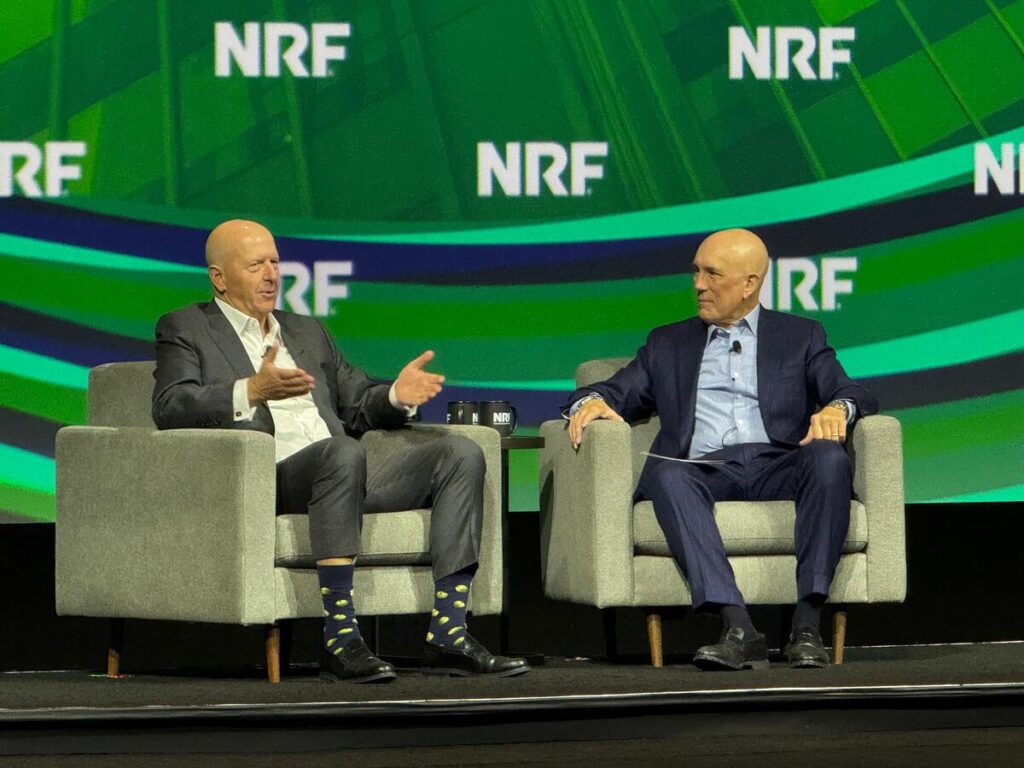
During NRF 2025, Matthew Shay, CEO of the National Retail Federation (NRF), interviewed David Solomon, Chairman and CEO of The Goldman Sachs Group Inc., in a revealing conversation about the global economy, technological innovation, and the challenges facing business leaders.
The conversation was a masterclass in how resilience, innovation, and strategic leadership can shape the future of retail and global business. Check out some of the topics covered during the session!
1. U.S. economic resilience as a global engine
David Solomon opened by highlighting the central role of the United States as the world’s leading economic power. He emphasized the country’s resilience in facing economic challenges and attracting investment.
“The United States remains a pillar of innovation and growth. There is extraordinary interest in being in the U.S., investing in the U.S., and living in the U.S.,” Solomon said.
Despite pressures such as inflation and a growing deficit, Solomon remains optimistic: “The U.S. economy has been incredibly resilient over time. Even with challenges, its foundation of innovation and productivity ensures a positive long-term outlook.”
2. Inflation and public debt challenges
Inflation, although more under control in some respects, remains a concern, especially with the federal deficit reaching historically high levels. Solomon warned:
“We need to better manage public spending and debt levels, because they directly affect investor confidence and economic growth.”
For retail, these challenges mean more cautious, value-focused consumers, which requires brands to be more strategic with their offerings and promotions.
3. The Artificial Intelligence revolution
Technology, especially artificial intelligence (AI), was singled out during this NRF session as one of the core drivers of the future of business. Solomon noted:
“We’re at the beginning of a cycle that will transform productivity across companies. AI tools are more accessible and have the power to improve people’s lives and optimize businesses.”
He also compared the AI adoption curve to previous technology cycles, predicting a profound impact over the next 5-10 years: “Although hardware costs are still high, advances in chips and infrastructure will bring those prices down, making the technology even more accessible to companies of all sizes.”
It’s also worth stressing that, for retail, AI opens up a wide range of opportunities for improvement and growth, for example:
- Personalized shopping experiences, with more relevant interactions;
- Operations automation: from inventory management to customer service;
- Demand forecasting, improving planning accuracy and reducing waste.
And that’s not all: AI is expected to keep evolving and improving, bringing a variety of benefits to the most diverse industries.
4. Rebalancing supply chains
The pandemic and geopolitical tensions have forced companies to reassess their supply chains, with a greater focus on resilience and localization. Solomon explained further:
 “We’re seeing a strategic restructuring in sectors such as chips, rare minerals, and healthcare. While these changes take time, they’re necessary to ensure resilience and security.”
In retail, this transformation means greater reliance on local suppliers, reconfigured inventories, and investment in logistics innovation, mainly to keep pace with changes in the value chain.
5. A more cautious, yet resilient, consumer
Solomon pointed out that the American consumer is still recovering, dealing with challenges such as inflation and economic uncertainty. “Inflation is extraordinarily punitive, especially for lower-income families,” he observed.
However, he also pointed to signs of resilience: “Despite the difficulties, consumers continue to sustain a large share of economic activity, seeking value and differentiated experiences.”
For retail, this reinforces the importance of offering: competitive, value-driven pricing; hybrid experiences that seamlessly integrate physical and digital; and relevant, personalized products, especially to meet consumers’ rising expectations.
6. Building organizational resilience
The conversation at NRF 2025 also addressed the importance of leadership and corporate culture in times of uncertainty. Solomon shared his view on how leaders should align their teams around clear values and goals.
“At Goldman Sachs, our values – integrity, partnership, and client service excellence – are the pillars that guide all of our decisions,” he explained.
He stressed that leaders must invest in talent and build strong organizational cultures capable of withstanding challenges and adapting quickly to change.
NRF 2025 takeaway: navigating the future of retail and business
 The dialogue between Matthew Shay and David Solomon made it clear that resilience, innovation, and leadership are essential to facing the uncertainties of the global economic landscape. For retail, the future will be defined by how companies adopt emerging technologies, restructure their operations, and meet consumers’ evolving needs.
As Solomon concluded at NRF 2025: “Organizations that manage to align themselves with these strategic transformations will be well positioned to lead in the future.”
What about you? How are you tackling economic challenges and seizing innovation opportunities in retail? Share your ideas with us!
Inscreva-se em nossa Newsletter
Receba no seu email todas as novidades do nosso blog sobre tecnologia e varejo, além de ficar por dentro do novos projetos Alice Wonders.