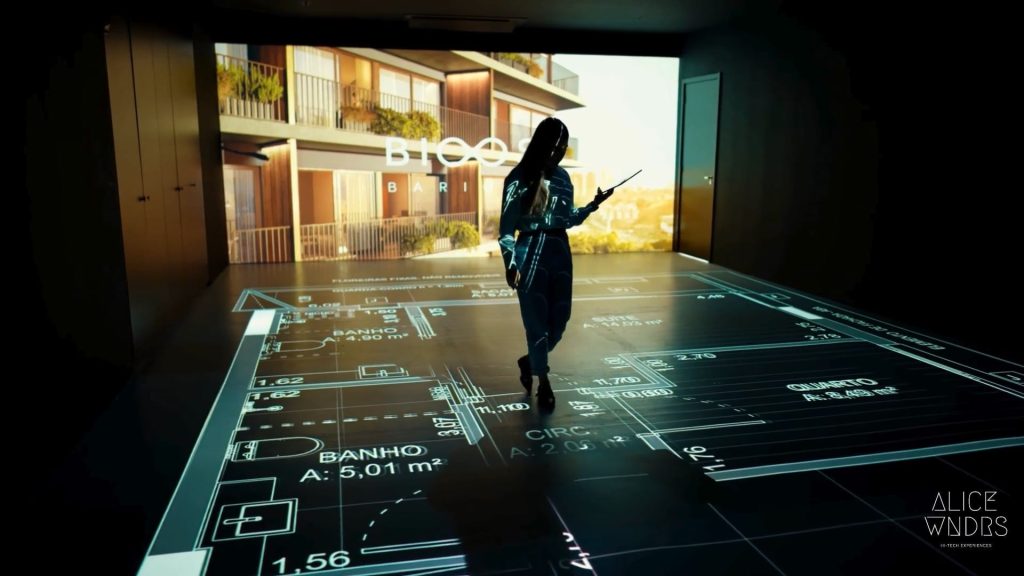
In this article, we’ll explore what immersive experiences at the POS are, and what they aren’t.
With consumers becoming increasingly demanding and well-informed, the traditional store shelf is no longer enough.
So, as a retailer, what do you offer beyond the product? This is where immersive experiences come in.
This concept has been transforming the way customers interact with brands, products, and even with each other, taking the shopping journey to a whole new level.
The Concept of Immersive Experience
But what exactly are immersive experiences? They are strategies built around the clear intention of capturing the customer’s full attention, making them feel like part of a narrative or environment rather than just a spectator.
It’s a combination of advanced technology and an appeal to our five human senses. When done well, this interplay gives customers the feeling of being “immersed” in a world created especially for them.
Whether through screens that transport them into a digital environment or through carefully chosen scents that evoke memories and sensations, the goal is clear: to connect deeply with the customer and create an unforgettable experience.
And at the POS, this concept becomes even more crucial, since the physical environment offers countless opportunities for this immersion to happen.

The Transformation of Retail and the Rise of Immersive Experiences
Retail, as an industry, is known for its ability to adapt. Over the years, we’ve seen brick-and-mortar stores evolve in response to a variety of factors – from economic shifts to the rise of the digital age.
And amid this ongoing metamorphosis, one thing has become clear: customers’ growing demand for richer, more engaging experiences. Why this shift? The answer is twofold: competition and technology.
The retail market has never been more saturated. For you, the retailer, every customer who walks into your store has countless other options at their disposal. In this fiercely competitive landscape, differentiation has become vital.
But the idea of creating a unique experience isn’t entirely new. Remember the food samplings at the supermarket or the product demos at electronics stores? Those were earlier, albeit simpler, attempts to engage customers. But what used to be a free sample or a simple demonstration has evolved.
Today, thanks to technological innovation, retail can transport customers into digital environments, letting them try products in virtual settings or even enhance the reality around them through augmented reality.
So what we’re witnessing is a fascinating intersection: the charm of traditional retail meets the brilliance of new technologies. From the smell of fresh bread at a bakery that takes us back to childhood, to trying out a piece of furniture in our living room through an augmented reality app, retail is redefining what it means to offer an ‘experience.’
And at the heart of this revolution are immersive experiences, building bridges between the tangible and the virtual, between a nostalgic past and an exciting future.
Essential Characteristics of Immersive Experiences – What Are Immersive Experiences at the POS, and What Aren’t They?
Not all experiences are created equal. Some are passive, while others, the immersive ones, have the power to transport customers, making them feel, live, and breathe what the brand wants to convey. But what exactly makes an experience truly immersive?
- Full Sensory Engagement: A truly immersive experience goes beyond sight and sound. It seeks to engage all five senses. Whether it’s the touch of a high-quality fabric, the distinctive scent of a perfume, or the taste of gourmet food, the idea is to immerse the customer in a setting where every sense is activated and delighted.
- Real-Time Interaction: Immersive experiences often allow customers to interact with and change the environment around them. This can be done through touchscreens, motion sensors, or virtual and augmented reality devices.
- Technology Integration: Technologies, especially augmented and virtual reality, are often the pillars of immersive experiences. For example, augmented reality can overlay digital information onto the real world, helping customers visualize how a specific sofa would look in their living room.
- Coherent Storytelling: Behind every successful immersive experience, there’s a continuous story. This narrative guides customers, giving meaning and context to their journey and ensuring that every interaction has a clear purpose and direction.
- Personalization: One of the biggest advantages of immersive experiences is the ability to tailor them to individual customer preferences. Based on data and past behavior, technology can adjust the experience to meet each customer’s specific needs and desires.
- Immersive Environment: Whether through projection mapping that transforms a space into a dreamlike setting, or virtual reality environments that transport users to different worlds, creating a fully engaging environment is essential.
Check out these examples of immersive experiences:
What Does Not Constitute an Immersive Experience
Now that we’ve covered the characteristics of Immersive Experiences, let’s look at what does not count as immersive technologies and environments.
The retail world is increasingly fascinated by immersive experiences and the transformative impact they can have on customer-brand interaction. However, along with this wave of interest, some misconceptions have also emerged about what actually makes an experience immersive. Let’s clear that up.
- Merely Digital Doesn’t Mean Immersive: Yes, many immersive experiences are powered by advanced digital technology, but simply having a digital interface (like an interactive kiosk or a touchscreen) doesn’t automatically make an experience immersive. Immersion happens when technology is used to create a deeper, more engaging connection with the customer, not just to digitize a function that used to be analog.
- Advertising Isn’t Immersion: A stunning TV commercial or an interactive billboard can grab attention and be memorable, but that doesn’t make it immersive. Immersion implies a depth of engagement that goes beyond mere observation. It activates multiple senses and lets the customer be an active participant, not just a spectator.
- One-Off Activations Versus Lasting Experiences: A truly immersive experience is more than a simple “touchpoint.” It’s not an isolated event but an ongoing journey that deepens the relationship between the brand and the customer over time.
- Superficial Personalization: Suggesting products based on a customer’s past purchases is a form of personalization, but it isn’t necessarily immersive. An immersive experience goes deeper, adapting and responding to the customer’s unique emotions, behaviors, and desires in real time.
- Empty Spectacles: Some brands, in an attempt to create something “viral” or remarkable, may put on big spectacles or installations. But if these activations lack a clear purpose or a genuine connection with the brand and the customer, they won’t be truly immersive. They’re just noise.
Once you understand these distinctions, it becomes clear that creating immersive experiences isn’t just about using the latest technology or following the latest trend. It’s about deeply understanding your customers and using every tool available – technological or not – to engage them in meaningful, memorable ways. In the end, an immersive experience at the POS is one that resonates, that is felt, and that, above all, is authentic.
Conclusion
In a world where consumers are constantly bombarded with information and options, authenticity and connection become the real differentiators.
Immersive experiences emerge as a direct response to this demand, fostering a deeper relationship between brand and customer that goes beyond the simple purchase transaction.
For you, as a retailer, it’s not just about keeping up with trends, but about recognizing how consumer behavior is evolving. Adopting truly immersive experiences can be the key to deeper engagement, greater customer loyalty, and, as a result, lasting success in today’s retail landscape.
If retail used to be mostly about products, today it is, without a doubt, about people, emotions, and experiences.
Frequently Asked Questions (FAQ)
- What really defines an experience as “immersive”? An immersive experience is one that deeply engages the consumer, activating multiple senses, and enables a deeper connection with the brand, often by blending the physical and digital worlds.
- Are immersive experiences only for big companies with big budgets? Not necessarily. While some immersive solutions, especially those using cutting-edge technologies, may require significant investment, there are many ways to create engaging customer experiences that fit different budgets.
- Will immersive experiences replace traditional retail practices? They aren’t meant to replace them, but rather to complement and enrich traditional practices. Even with the growing adoption of technology-driven immersive experiences, human interaction and the personal touch remain essential in retail.
- How can I start integrating immersive experiences into my POS? Start by identifying the touchpoints that matter most to your customers and think about how you can make them more engaging. Partnering with specialists or companies that already have experience in immersive experiences can be a good first step.
- Are immersive POS experiences just about technology? No. While technology can be a powerful tool for creating immersion, a truly immersive experience also involves understanding customers’ emotions and desires and responding to them in meaningful ways. Technology is just a means to that end.
Inscreva-se em nossa Newsletter
Receba no seu email todas as novidades do nosso blog sobre tecnologia e varejo, além de ficar por dentro do novos projetos Alice Wonders.