



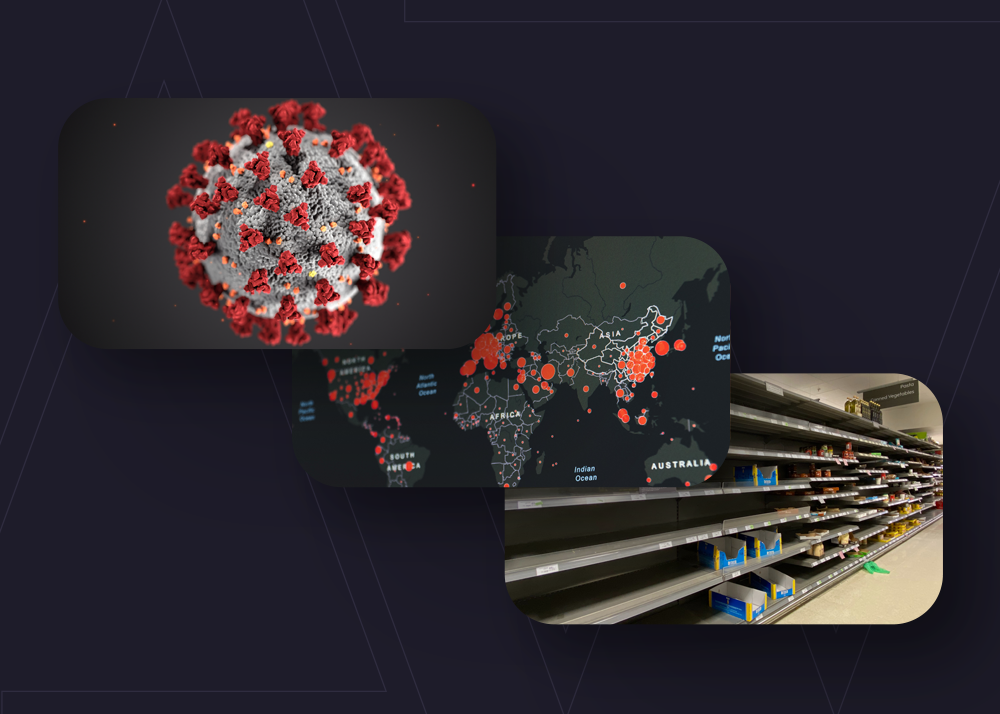
COVID-19: Impact on Retail vs. Opportunity in the Crisis Comments Off on COVID-19: Impact on Retail vs. Opportunity in the Crisis 4344

COVID-19 header

With COVID-19 spreading across Brazil in recent weeks, the impact on retail has been forcing companies across many industries to adapt to the new way of consuming. From multinationals to small businesses, everyone needs to keep up with shifts in consumer behavior in order to push back against the crisis and soften its effects on their business.

Measures to contain the novel coronavirus
Measures to contain the novel coronavirus have caused major changes in consumer behavior.

Deliver value to your customers

In times of crisis, a strong brand is a strategic differentiator and builds consumer trust. If you want to survive the post-crisis period, building brand equity for your business becomes even more strategic in the current context. That’s why working on your branding right now can be the gateway to customers who didn’t use your service before.

First, you need to understand how consumer habits are changing through data mapping, which will yield insights for creating promotions, increasing inventory of a product, launching campaigns, and other activations. For example, sensors installed in the physical store capture customer movement and show which section has the highest concentration of people, or how long someone stood in front of a shelf in a given category. This is the data that feeds back into your business’s marketing strategies.

The main goal now is to think about how to make people’s lives easier and how your brand can contribute in a natural way. In other words, it’s about seeing opportunities in the middle of the crisis and putting your brand’s mission into practice. It’s important to view these strategies as the beginning of a long-term relationship.

How major brands have changed the way they operate

The quarantine in the state of São Paulo takes effect this Tuesday (the 24th), making the outlook even more promising for app-based delivery services. Anticipating the situation, McDonald’s, Burger King and other fast food chains changed the way they operate by expanding their delivery infrastructure.

Photo reproduction from McDonald's Brasil social media
Photo Reproduction: In a post on McDonald’s Brasil’s official Facebook page, the company announced “Mc Delivery.”

Burger King, meanwhile, posted on its official Instagram profile that it has consolidated its delivery presence, now with Uber Eats, Rappi and iFood.

Another important example is Ambev, which converted its production line to make hand sanitizer gel, to be donated to public hospitals in São Paulo, Rio de Janeiro and Brasília, the cities with the most coronavirus cases so far.

Ambev hand sanitizer

Overview: Impact on retail in Brazil and worldwide

As mentioned above, the COVID-19 pandemic has been impacting retail through shifts in consumer behavior. Overall, online sales have increased across several product categories. Meanwhile, brick-and-mortar retailers that remain open are adopting new contactless delivery formats.

A study by Google Retail AIT shows retail data from January to March 2020 and what people have been searching for online. Searches for entertainment, personal care and cleaning products saw the biggest increases last week.

These behavioral trends were analyzed in countries where the pandemic has already reached more critical stages, making it possible to predict scenarios retail may face in Brazil.

Focus on prevention

Among retail categories, Personal Care and Cleaning stand out the most, with searches averaging 30% higher. The growing demand is tied to products such as hand sanitizer and face masks.

Cleaning chart. Source: Google Retail AIT
Source: Google Retail AIT
Chart: searches for hand sanitizer Source: Google Retail AIT
Source: Google Retail AIT

Food Retail

Food retail saw an acceleration in searches for non-perishable categories, driven by stockpiling behavior. There is also strong demand for recipes people can make on their own.

Chart: searches for food. Source: Google Retail AIT
Source: Google Retail AIT

A study by Nielsen points to higher demand for the following foods:

Powdered milk +84%

Grains +37%

Canned meat +31%

Rice +25%


Life in quarantine

Searches for entertainment, food and personal care are gaining relevance as people cope with forced isolation.

Chart: searches across multiple categories. Source: Google Retail AIT
Searches for entertainment, personal care and cleaning products saw the biggest increases last week. Source: Google Retail AIT

Fashion retail

Since they are not essential categories, fashion, furniture and travel goods saw the steepest declines.

Chart: Fashion searches in other regions. Source: Google Retail AIT
Fashion searches in other regions. Source: Google Retail AIT

With all these changes, what can we expect in a post-crisis scenario? Understanding the current moment and riding the wave of the crisis, truly grasping consumer needs and how their behavior is changing, both online and in physical stores, are fundamental to follow, not only in these times of change but from here on out, for the health of your business.

Inscreva-se em nossa Newsletter

Receba no seu email todas as novidades do nosso blog sobre tecnologia e varejo, além de ficar por dentro do novos projetos Alice Wonders.

Thank you for subscribing.

Something went wrong.

Previous ArticleNext Article

Why Is Working with Data Important for Your Store? Comments Off on Why Is Working with Data Important for Your Store? 1188

dados

Did you know that by collecting data from your customers, you can transform your store and improve sales, making them increasingly targeted and qualified?

That’s because working with data is one of the biggest differentiators in retail: it provides valuable information that can help you build an efficient sales funnel and make strategic decisions.

Data collection at the POS (Point of Sale)

The moment a customer walks into your store, they leave behind a trail of valuable information. From purchasing behavior to interactions with specific products, every customer action can be turned into data that helps you better understand their preferences and needs.

When analyzed correctly, this data generates insights that go beyond surface-level observations, enabling more strategic actions.

How does data help the sales funnel?

By observing customer behavior, you can map each stage of the sales funnel — from attraction, through engagement, all the way to conversion. This lets you personalize the shopping experience, increasing your chances of closing the sale.

With data collection, you can, for example, understand which products draw the most attention, which areas of the store generate the most traffic, and even predict customer preferences, delivering personalized offers.

-> Meet Granometrics.io

Alice Wonders’ Granometrics.io is an innovative multisensor platform that turns the physical store into a powerful source of data for strategic decision-making. Using advanced technology, it maps the store’s physical space, analyzing and delivering insights so retailers can act with greater precision and efficiency.

On top of that, Granometrics.io lets you measure shopper interest, map behavior by zone, and analyze interest by category and SKU.

The platform offers a granular, strategic view that helps optimize operations, improve the customer experience, and maximize sales results in the physical environment. It’s an essential solution for anyone looking to combine innovation and performance in retail.

What are data and insights?

Although many people confuse the two terms, it’s important to understand that data is the raw information you collect. Insights, on the other hand, are the conclusions or actions that can be drawn from that data.

By embracing a Data-Driven culture, your store becomes more efficient, making decisions based on real information rather than assumptions. For example, data might show that a certain product is in high demand, while an insight reveals how to position it better in the store to maximize sales.

The importance of a Data-Driven approach

Adopting a Data-Driven approach means making informed, strategic choices. If you’re not collecting this data, you’re missing out on valuable opportunities to optimize your business. With the right analysis, you can identify trends, anticipate customer needs, and proactively adjust your product offering.

In addition, a well-structured POS, built on data and insights, helps improve the customer experience. By better understanding consumer behavior, you can create a more appealing environment, with products and offers that truly meet your audience’s expectations, fostering loyalty and boosting retention rates.

Conclusion

Investing in data and insights isn’t just about modernizing your store; it’s about building a solid sales strategy grounded in a deep understanding of your customers. By using this information correctly, you can optimize your sales funnel, increase conversion, and deliver richer, more satisfying experiences to your consumers.

Inscreva-se em nossa Newsletter

Receba no seu email todas as novidades do nosso blog sobre tecnologia e varejo, além de ficar por dentro do novos projetos Alice Wonders.

Thank you for subscribing.

Something went wrong.

Japan as a Lens for an Introduction to Regenerative Economies Comments Off on Japan as a Lens for an Introduction to Regenerative Economies 1236

Retail makes visible the linear mindset of the current economy, grounded in the operational logic of the supply chains that govern it (extract, produce, and discard). As the engine that keeps the cycle between extracting natural resources and discarding what we produce with them spinning at full speed, retail feeds our obsession with the new: new products, new campaigns, new stores, new technologies, and so on.

This much acceleration fuels the adrenaline that attracts passionate, restless doers, but that same speed breeds demotivation when details aren’t cared for, reflecting a lack of purpose in the industry’s strategic direction. The way we look at technology is a classic example. Retail’s enthusiasm for novelty brings a certain dazzlement with digital technologies, and seeking them out, learning about them, and applying them have, in many cases, become innovation goals in themselves.

Digital technology is a principle intrinsic to every movement and behavior of an era we’ve labeled the “Digital Age,” and it may or may not be tied to a step toward innovation for a retailer. As a means to innovation, technology has purpose when it’s tied to the common goal of every person, professional, and business: the transition from the current economy to regenerative economies, which are about the survival and evolutionary sustainability of all our lives, as human beings who belong to and inhabit nature. Put literally: without life, what’s the point of technology?


ILLUSTRATION OF THE REGENERATION PROGRAM THROUGH THE LENS OF THE PASSION ECONOMY, BY PAULA COSTA: regeneration represents a new era [digital, governed by consciousness], which calls for a new production logic: we are moving from the LINEAR chain (extract, produce, and discard) to the SYSTEMIC chain (non-linear, creative, and REGENERATIVE).

The regenerative economy mindset brings words like “transformation” and “reframing” onto the business agenda, reclaiming the core principle of innovation: the different, and not necessarily the new.

One step toward this movement is, for example, instead of creating a brand-new plan, focusing on evolutionary continuity: revisiting what already exists and questioning what can be improved, revised, dropped, or created from what has already been thought through – since we’re getting close to the big retail event in New York, NRF, how about thinking not only about the new cases and stores, but going back to the ones we’ve heard about in recent years to understand how they’ve been sustained and how they’ve evolved?

“Curiosity generates regeneration, moving us forward, reaching and even surpassing our goals, while a culture driven solely by goals leads to scarcity. The book ‘The Power of Moments’ cites research showing that companies focused on happy, satisfied customers (who represent abundance) achieve higher annual revenue growth than companies focused only on winning back unhappy customers (who represent scarcity)” – that was the insight from Ale Valdivia, co-CEO of Alice Wonders, after reading the introduction to “Japan & Regeneration,” a resource available at the end of this article.

Just as technology gets confused with innovation, many retailers still place sustainability solely within the scope of marketing.

We need to recognize that the change we started noticing through the “ESG” movement, including the transition from linear chains to regenerative chains, doesn’t only affect production or communication; in an integrated way, it also relates to how we consume, work, relate to one another, and more. It’s a change in the way we live and, therefore, in how the economy works.

As an inspiring starting point for this cultural transition, I’ve shared reflections from a recent trip to Japan, looking for references to the era of regenerative economies and to the application of the Passion Economy as an innovation methodology for helping organizations transition into this new era.

I invite you to access the full material here, covering all the topics below, whose titles alone already convey the values that underpin a culture of innovation through the lens of the Passion Economy and the mechanics of regenerative economies:

  1. EDUCATION & RESPECT

  • Community depends on belonging, and belonging nurtures and is nurtured by ownership
  • A Vision of Purpose
  1. COMMITMENT

  • Constant Learning
  • The importance of beauty in everyday life
  • Timelessness
  • Bonds with and honor for origins and traditions
  1. SILENCE

  • The ability to focus
  • The multiple dimensions of the senses
  1. ESCAPE VALVES

  • The art of celebrating
  • Playfulness and the unreal
  • Surprise, fun, and delight
  • Tolerance and acceptance of failure and mistakes
  1. AWARENESS OF ENDINGS

  • Past and future connected to the present
  • Vintage culture, resale, and upcycling
  1. IMMATERIALITY & SPIRITUALITY

  • Reverence for and connection to nature
  • Minimalism: less is more
  1. RITUALS

  • The logic of abundance
  • Portals
  1. CARE

  • Recognizing the role each part plays in the whole
  • Everything starts from the inside out
  • Hospitality
  1. BRAZIL [and our huge potential!]

  • We don’t need to travel to move forward!

Paula Costa is a communications professional with an undergraduate degree in Advertising and an MBA in Retail Management from ESPM, plus complementary specializations in market intelligence, research, anthropology, futurism and innovation, and has studied at global institutions such as Hyper Island and Tel Aviv University. Based in Europe, she travels across different countries and attends art, design, technology, innovation, business and retail events, curating behaviors, movements and trends that feed the insights she shares in global innovation groups, as a LinkedIn Creator and supporter of Fashion Revolution Brasil, as well as in graduate and MBA courses at institutions such as ESPM, talks, workshops, mentoring and consulting on trends, strategic intelligence and innovation. Her work is grounded in the vision of the Passion Economy, the subject of the book she co-authored and the focus of the project she co-created, Inquietesi: a Passion Economy lab for the transition to the Digital Age, guided by Consciousness.

Instagram and LinkedIn | @paulacoliv | Linktree: https://linktr.ee/paulacoliv

Inscreva-se em nossa Newsletter

Receba no seu email todas as novidades do nosso blog sobre tecnologia e varejo, além de ficar por dentro do novos projetos Alice Wonders.

Thank you for subscribing.

Something went wrong.

Most Popular Topics

Editor Picks

Send this to a friend



