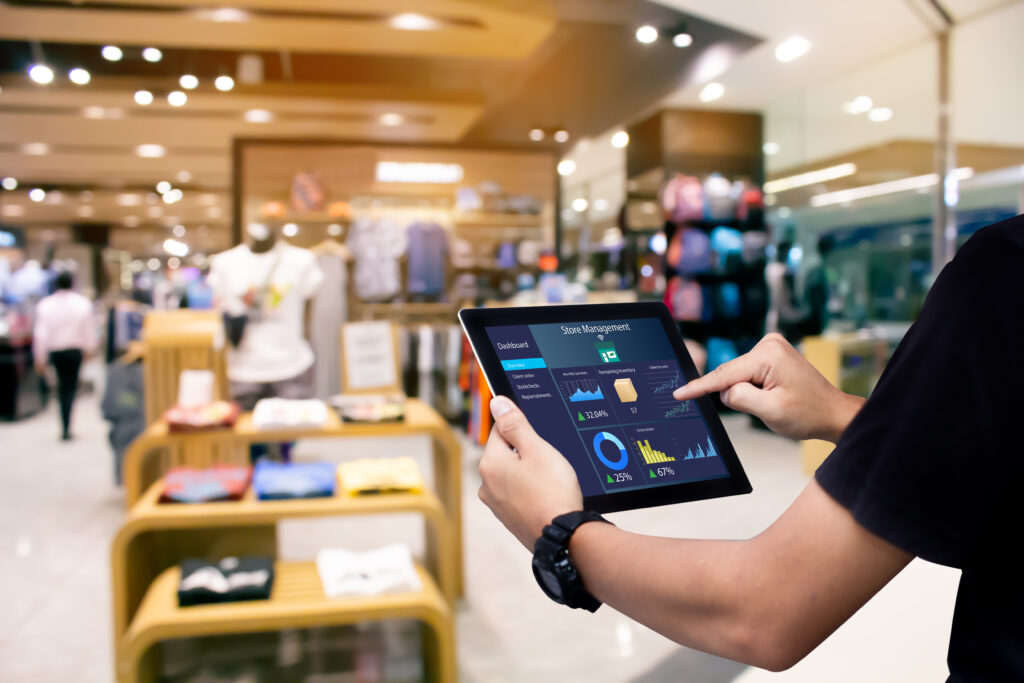
The use of Big Data in retail is a recent development! Not long ago, large datasets couldn’t be processed by systems that were cost-effective for businesses. That meant companies needed high-performance computers and had to invest heavily in hardware.
The advent of Big Data changed that reality dramatically. Now, it’s possible to analyze a wide range of information in the cloud at competitive prices and uncover trends, consumption patterns, and associations that help businesses improve their operations and their relationships with consumers.
Retail is one of the markets that stands to benefit most from Big Data. But is it ready to put the solution to work? The answer to your questions is right here. Keep reading to find out!
What are the possibilities of Big Data in retail?
Every organization can benefit from Big Data, but not all of them manage to use it efficiently.
Retail is one of the business sectors that sees the most results from applying data-driven technologies. However, figuring out which information is actually useful for achieving the expected results is the biggest challenge.
Artificial Intelligence, Machine Learning, BI systems, and Analytics are the tools that make Big Data work in a business’s favor. On their own, however, they can’t work miracles.
You need to apply Data Science with a focus on the brand’s goals and have a well-defined strategy. When that happens, Big Data opens up a sea of possibilities, such as:
- getting accurate sales forecasts for specific periods;
- better understanding customers’ behavior, expectations, and lifestyle;
- assessing how people feel about your brand;
- creating customized promotions that bring more people into stores;
- optimizing store design to deliver better shopping experiences;
- building websites that convert more and e-commerce pages with high sales rates;
- understanding the decision-making process;
- improving the supply chain and managing inventory more effectively; and
- getting a 360° view of the customer journey.
What challenges do companies face in adopting it?
Getting access to customer data is the main challenge to successfully implementing Big Data — we can call it the small data problem.
Data leaks, misuse of information, and the desire for privacy have changed the way users view the data they hand over to companies. So the first task for anyone who wants to master Big Data is to earn the customer’s trust.
That’s easier to do when you invest in security options. A company that commits to following compliance standards, such as the GDPR (the European law that regulates the use of data and requires businesses to clearly communicate how it is stored and used), and makes it through this stage is more likely to grow with insights from Big Data.
Identifying what other types of information a brand needs when building a Big Data cluster is also important. After all, not all the data a company uses necessarily comes from consumers.
There are public databases, such as those from IBGE, market research conducted by large organizations, weather and environmental reports, and many other datasets that can be combined to establish cause-and-effect relationships.
To do this, you need to find out which ones have the greatest impact on your store in order to unlock the full potential of Big Data in retail.
How does retail use Big Data?
To understand the kind of disruption Big Data brings to retail, we need to look at a few case studies.
So, take a look below at how technology has been helping companies achieve a higher ROI on their Marketing initiatives and build better relationships with consumers:
Gaining deeper customer knowledge
According to the consulting firm McKinsey, over the next five years we’ll see more retailers investing in Big Data. With an ROI of 15 to 20%, it’s already part of Marketing activities, is integrated into e-commerce, and is starting to take its first steps toward improving store management.
In most use cases within these retail departments, Big Data is applied in the form of Data Discovery. Software such as Hadoop sifts through thousands of pieces of information accumulated by retailers and external sources, enabling companies to know their customers as well as the people closest to them do.
There have already been cases in which Big Data in retail allowed companies to become so familiar with consumers’ lives that they anticipated information the consumers themselves didn’t yet know.
To give you an idea, the American company predicted a pregnancy simply by tracking the products a customer was buying. Using a list of 25 items that women purchase in the period immediately before pregnancy, such as moisturizers made with cocoa butter, it not only uncovered this information but was also able to pinpoint when the young woman would have her baby.
This level of data granularity is extremely useful for a store to send specific offers to its customers, with the right timing to motivate them to buy more.
Creating high-impact initiatives
With the shopper knowledge that stores gain through Big Data, the challenge of creating high-impact campaigns becomes smaller. So-called Data-driven Marketing is a more targeted way to reach consumers and get results.
Picture an email marketing campaign: with the right information, it can convert precisely the right customers by micro-segment, using personalized messages to grab their attention.
According to a study by ClickZ, a company specializing in online strategies, using data increases conversions among customers who have stopped buying from a retailer by up to 20%.
Optimizing store layouts
Big Data’s performance has a lot to do with the data that feeds the systems. That’s why the more information a company can collect, the greater its ability to apply it to tasks as complex as changing how products are distributed across stores.
In this sense, RFID sensors are great partners in generating insights. Used to map customer movement through stores, they capture important data for optimizing retail layouts.
Watches of Switzerland, based in London, built a data-driven megastore in 2014. Spread across three floors, each one designed to serve a different persona (enthusiasts, connoisseurs and collectors), the store integrates other technologies, such as interactive displays, to meet consumer demands.
Big Data is revolutionizing retail around the world through the power of data. It’s clear that decision-making backed by insights delivers better results. So it’s essential to overcome its challenges and tailor its applications to each company’s needs.
Do you have a better understanding of how Big Data works in retail? Are you already using it in your business? Share your experience with us.
Inscreva-se em nossa Newsletter
Receba no seu email todas as novidades do nosso blog sobre tecnologia e varejo, além de ficar por dentro do novos projetos Alice Wonders.
Thank you for subscribing.
Something went wrong.
Respeitamos sua privacidade e levamos a sério a sua proteção