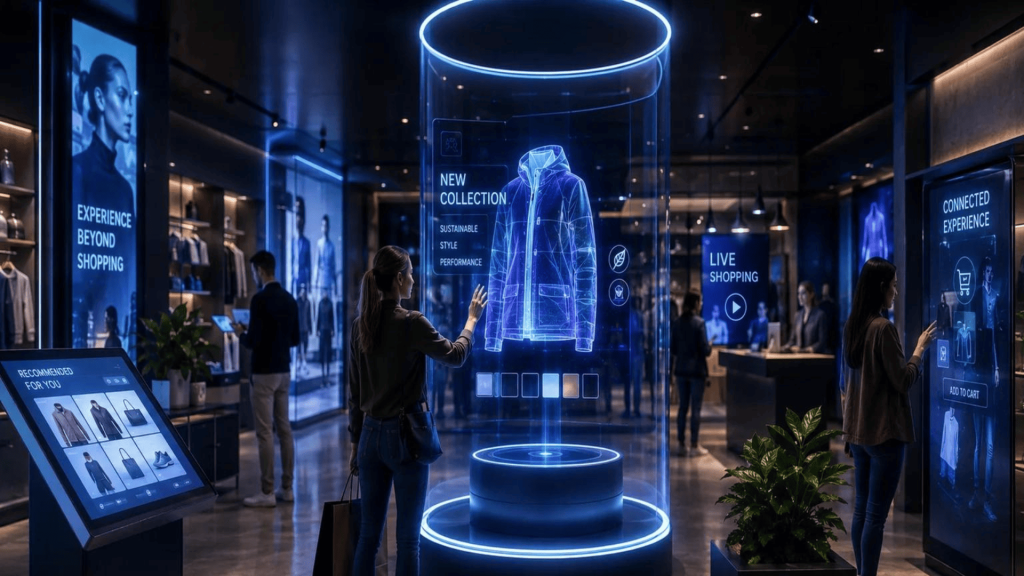
Smart Store Windows and Holographic Displays: The Future of Visual Merchandising Comments Off on Smart Store Windows and Holographic Displays: The Future of Visual Merchandising 782

Over the years, window display design and visual merchandising have evolved from purely aesthetic strategies into powerful tools for communicating and connecting with consumers.

In an increasingly competitive and dynamic market, the way products are presented at the point of sale can make the difference between catching a curious eye and going completely unnoticed.

Against this backdrop, retail merchandising is undergoing a true transformation, driven by technology and by customers’ new expectations. Store windows, traditionally static, are now coming to life and becoming interactive.

What used to be just an attractive visual composition is now becoming a complete sensory experience. We are entering a new era in which concepts like holographic displays and holography are starting to take center stage in retail strategies.

Imagine walking past a store window and being surprised by a product projected in 3D, floating in midair and moving gracefully. It is this blend of enchantment and innovation that has been shaping the future of the point of sale.

More than just grabbing attention, the store window now talks to the public. And that conversation happens through technology, creativity and a more strategic approach to visual merchandising. After all, in today’s retail, the window doesn’t just sell products — it sells experiences.

With that in mind, today we’ll explore the future of visual merchandising and the innovations this concept has brought to the market, with smart windows and holographic displays that are directly impacting the consumer experience.

Meet smart windows

Starting with smart windows, they represent a significant evolution in window display and visual merchandising strategies. Combining technology and creativity, they turn the point of sale into a dynamic, interactive and personalized environment.

Going far beyond aesthetics, this new window format delivers an immersive experience aligned with the expectations of today’s consumers – who are increasingly connected, demanding and eager for innovation.

But what actually makes a window “smart”? Features such as presence sensors, cameras, artificial intelligence and interactive screens make it possible to adapt content in real time based on the profile of whoever walks by.

A practical example: when it detects a customer approaching, the window can display products that match that person’s style or age group, making retail merchandising more relevant and personalized.

To give you an idea of how powerful this world is, a study titled “The Power of Visual Merchandising with Data-Driven Strategies to Boost Sales,” conducted by Clair Chapelle, an expert in visual merchandising strategy and retail operations, indicates that well-planned window displays can increase sales by up to 540%.

In addition, 70% of purchasing decisions are made at the point of sale, and well-executed displays can increase sales by 30%, with strategic placements (such as at eye level) accounting for 52% of retail sales.

This intelligence applied to the point of sale also paves the way for holographic displays. Through holography, products can be presented in three dimensions, as if they were floating right in front of the consumer – an experience that delights and holds attention, turning the window into a true technological stage.

This transformation not only modernizes the physical space but also expands the strategic possibilities of visual merchandising. In a market where the battle for attention is fierce, smart windows are a bold and effective response to the need to innovate in retail merchandising.

Holographic displays: where the future meets retail

And of course, we couldn’t leave holographic displays out, especially since technology has been opening up surprising new paths for window display and visual merchandising, and among the most important innovations is the use of holographic displays at the point of sale.

Holography, once confined to the world of science fiction or major tech events, is now finding its place in everyday retail as a powerful tool to attract, engage and delight consumers.

Holographic displays work by projecting three-dimensional images that appear to “float” in midair, without the need for special glasses or visible screens. This optical illusion can turn a simple product launch into a true visual spectacle, sparking curiosity and increasing the time people spend in front of the window.

It’s technology serving the purpose of moving people and creating a memorable connection — key elements in today’s retail merchandising. Beyond the visual impact, holography adds value to the brand narrative, positioning the brand as innovative and in tune with the trends of the future.

Brands that invest in this technology get ahead by turning their windows into experience points, going beyond simply displaying products. This new window model reinforces the idea that window display and visual merchandising need to keep pace with the evolution of consumer behavior, as shoppers seek unique and personalized experiences.

By adopting holographic displays, retail merchandising takes a bold step toward the digitalization of physical spaces, proving that innovation and enchantment go hand in hand when it comes to winning customers’ attention and hearts.

Why are these technologies shaping the future of VM?

Diving deeper into this world, it’s time to understand some of the reasons why these technologies are shaping the future of visual merchandising and to get to know brands that have bet on this strategy and achieved great results. Take a look:

Personalized experiences that build connection

The rise of technologies such as holographic displays and smart windows isn’t just a passing trend, but a concrete response to shifts in consumer behavior and to new market demands.

Today, those working in window display and visual merchandising need to go beyond an attractive visual composition: they need to deliver experiences that captivate, communicate and convert. In this context, holography stands out as an innovative and highly impactful solution, capable of completely transforming how the point of sale is perceived.

The Brazilian company DEAL, for example, has developed smart windows that use facial recognition and artificial intelligence to identify characteristics such as customers’ gender and age.

Based on this data, the windows display targeted ads, delivering a personalized experience and increasing the relevance of the messages for each consumer, directly influencing their purchasing decisions.

Displays that delight and expand possibilities

Holographic displays play a key role in this new retail landscape: by projecting products in 3D in a light, dynamic, and surprising way, they significantly expand what’s possible at the point of sale.

This technology goes beyond simple display: it creates a true visual spectacle. More than just grabbing attention, this kind of presentation sparks shoppers’ curiosity, inviting them to come closer, explore, and interact with the brand in a more engaging and sensory way.

It’s about turning the shopping experience into something memorable, something that stirs emotions and strengthens the bond with the product. In this context, we can talk about Adhaiwell, a brand that stands out for introducing store windows equipped with 3D LED display pedestals, a solution that combines cutting-edge technology with innovative design.

These displays deliver a 360° visual experience, allowing products to be presented in their full dimension and motion, in a three-dimensional and interactive way. The result is a window display that doesn’t just showcase, but enchants — capturing attention and standing out strongly in the competitive retail environment.

Innovation as a competitive edge in retail

With consumers becoming increasingly demanding, connected, and in search of unique experiences in the market, we know all too well that brands investing in innovation and technology get ahead of their competitors.

Technologies like holography and smart windows don’t just modernize the point of sale; they also make retail merchandising more efficient, sustainable, and relevant, acting as a draw that won’t go unnoticed by the end consumer.

In an innovative collaboration, Fast Shop and Samsung developed an interactive window display for the launch of the Galaxy Z Fold3 5G and Z Flip3 5G. The installation allowed shoppers to interact with the display through QR Codes, accessing product videos and information directly on their smartphones.

The window featured different mood boards, such as Game, Health & Fitness, Office Productivity, and Creativity, offering a personalized and immersive experience that connected the audience to the products in an innovative way.

These points and cases show us that the technologies shaping the future of visual merchandising are directly tied to what has become indispensable to consumers: the experience. And those who bet on it are already light-years ahead!

The future is already here – and it’s visual

It’s no secret that the way we relate to physical spaces is changing, and retail is one of the sectors that feels — and responds to — this transformation the most.

Technologies like holographic displays, interactive windows, and smart sensors show that the future of window dressing and visual merchandising has already arrived, bringing with it a new concept of the point of sale: a space that doesn’t just display products, but delivers sensory, immersive, and memorable experiences.

In a landscape where consumers have access to everything in just a few clicks, retail merchandising needs to reinvent itself to stay relevant. And holography, with its power to enchant and innovate, emerges as a strategic ally for brands that want to stand out, create value, and capture the attention of an increasingly connected and demanding audience.

More than a visual trend, these technologies represent a shift in mindset. They show that innovating at the point of sale means investing in relationships, differentiation, and positioning.

Window dressing and visual merchandising, once based solely on aesthetics and product placement, now play a strategic role in retail, connecting storytelling, technology, and data to create unforgettable experiences.

The future of retail merchandising is being written right now — in windows that interact, products that float in midair, and brands that understand that surprising people is the best way to sell.

Inscreva-se em nossa Newsletter

Receba no seu email todas as novidades do nosso blog sobre tecnologia e varejo, além de ficar por dentro do novos projetos Alice Wonders.

Thank you for subscribing.

Something went wrong.

Previous ArticleNext Article

5 Brazilian stores innovating the in-store experience Comments Off on 5 Brazilian stores innovating the in-store experience 298

Loja física com tecnologia interativa e holograma para experiência do consumidor no varejo

Brazilian stores are going through a transformation. Some say physical stores are dying, but in reality, they are breaking free from sameness. Today, consumers don’t leave home just to buy a product they could get with a single click. They are looking for experiences, connection, and reasons to be physically present with a brand.

Brands that still treat their stores merely as inventory spaces, packed with products on display and traditional purchasing processes, are losing ground. The secret of today’s retail lies in the combination of technology, design, and human connection.

With that in mind, we’ve rounded up 5 Brazilian stores from different segments that are reinventing the physical experience and creating new ways to connect with consumers. These examples show how innovation can turn the point of sale into a strategic differentiator for retail.

1. Amaro: a new store experience

Amaro revolutionized the logic of physical inventory by introducing the Guide Shop concept. Instead of focusing on product volume and clothing racks, its stores work as dynamic showrooms where consumers can touch the pieces, try on styles, and find the perfect fit with the help of style consultants.

Purchases are made digitally through kiosks or QR codes, while products are shipped directly from a distribution center to the customer’s home.

This strategy reduces the need for in-store storage, eliminates steps from the traditional shopping journey, and allows the brand to test new collections more quickly.

2. Nestlé: technology to transform the point of sale 

In a project for Nestlé, the goal was to turn the consumer’s relationship with the products into an entertainment experience.

At the Chocotour Nestlé tourist attraction, Alice Wonders developed interactive digital experiences, custom self-service kiosks, and augmented reality filters.

In traditional retail, innovation also reached the point of sale with screens and holographic displays installed on store shelves. The technology helps capture consumers’ attention right at the moment of purchase decision. Click here to learn more about the project! 

3. Riachuelo: technology to streamline the journey

At its store in the heart of São Paulo, Riachuelo shows how technology can solve some of consumers’ biggest pain points inside a department store.

One of the major highlights is the smart fitting rooms. When customers step into the booth, interactive screens recognize the selected items through smart tags using RFID technology.

If customers need a different size or want to find an accessory to complete the look, they can request the item directly on the screen without leaving the fitting room.

The experience also features self-checkout stations and themed spaces with interactive elements, showing how technology can act as an enabler of the shopping journey.

4. Vans: when technology becomes invisible

For Vans, Alice Wonders’ approach was to show that technology applied to the point of sale can work as an “invisible finish,” enhancing the environment without stealing the spotlight from the product.

In the interactive showroom developed for the brand, screens and digital touchpoints were integrated into the fixtures and retail architecture.

Consumers can browse the full catalog, learn the story behind the sneaker models, and discover more about the collections in a seamless and intuitive way.

The experience combines Vans’ urban, authentic aesthetic with digital features that expand interaction inside the store. Click here to see the full case study!

5. O Boticário: immersive experiences in retail

O Boticário has also been exploring new possibilities to turn its stores into experiential spaces.

One of the highlights is the Immersive Tunnel at the O Boticário LAB flagship, a high-tech environment that envelops consumers with visual stimuli and lighting that responds to movement.

The brand also uses White Box technology, a realistic holography solution applied to the point of sale to bring campaigns to life and turn fragrance discovery into a three-dimensional experience.

The result is a more immersive, modern, and social media-shareable shopping journey. Click here to check out the details of this project!

What do these stores teach us about the future of retail?

These examples show that Brazilian stores don’t need to compete with digital. Quite the opposite: when technology, design, and strategy work together, the physical space can become a true destination for consumers.

The best experiences don’t use technology just to grab attention. They solve problems, streamline the journey, build connection, and make interactions with the brand more relevant.

It’s this combination that makes it possible to turn traditional stores into spaces that attract, engage, and convert.

More than selling products, these experiences show that the future of brick-and-mortar retail lies in the ability to create environments that offer something consumers can’t find on a screen.

Alice Wonders’ role in transforming retail 

If the market’s biggest success stories teach one clear lesson, it’s this: the future of physical retail belongs to brands that know how to connect the best of the physical and digital worlds.

Alice Wonders brings together design, technology, and architecture to create interactive experiences that turn points of sale into destinations.

More than simply adding screens or tech features to a store, our goal is to use technology as a strategic tool to make every interaction more relevant.

Brazilian stores are changing — and brands that understand this transformation will have new opportunities to build connection, generate value, and transform the customer experience.

Want to reinvent the physical experience at your point of sale? Click here to schedule a conversation with our team! 

Inscreva-se em nossa Newsletter

Receba no seu email todas as novidades do nosso blog sobre tecnologia e varejo, além de ficar por dentro do novos projetos Alice Wonders.

Thank you for subscribing.

Something went wrong.

The End of Traditional Window Displays? How Technology Is Redefining the Retail Storefront Comments Off on The End of Traditional Window Displays? How Technology Is Redefining the Retail Storefront 383

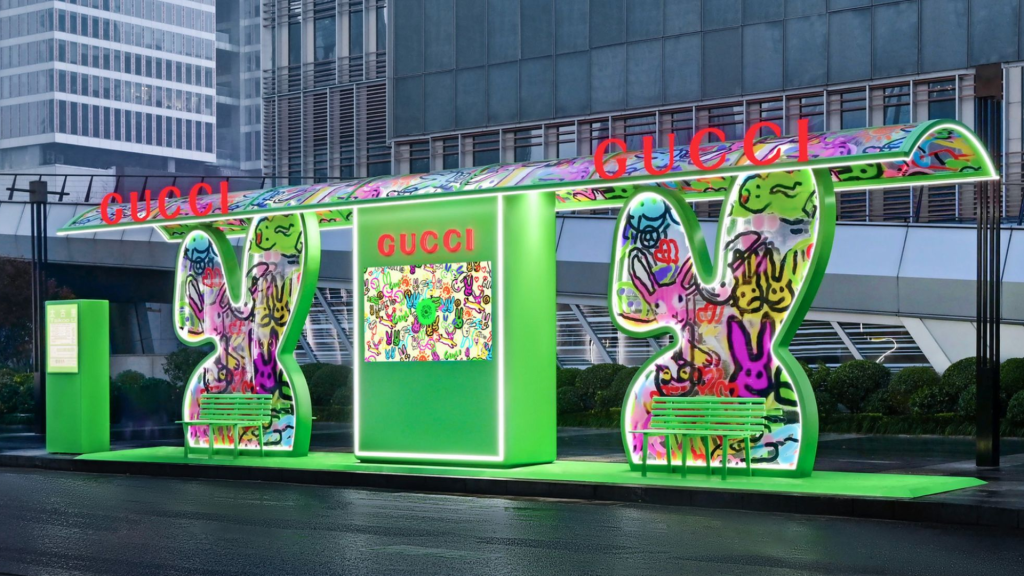
Vitrine tecnológica da Gucci com instalação interativa e iluminação verde em espaço urbano

What were the last three store windows you saw? Maybe you can’t remember, and that’s okay, because it’s only natural. The market has been shifting toward a new reality, one in which the windows that truly grab attention are no longer the ones that simply display a product. 

A shopper who is used to walking around with their face glued to their phone screen isn’t going to put it away to pay attention to a window featuring nothing but a mannequin wearing a new piece of clothing. Consumers have changed. They’re hyperconnected and crave dynamism. If your storefront has looked the same for a decade, it has become “invisible scenery.”

Traditional window displays aren’t necessarily dying, but the static model, the one focused solely on passively showcasing products, is living on borrowed time. That’s why, in today’s post, we’ll look at the reasons traditional window displays are dying out and the technologies emerging to take their place. 

Why are traditional window displays losing ground?

Today’s consumers are looking for more than transactions. After all, shopping has never been as easy as it is today. These consumers want products that create an emotional connection and memorable experiences. 

Competing with the convenience and personalization of e-commerce requires physical spaces to offer “something extra” from the very first touchpoint. And that first touchpoint, the one that grabs shoppers’ attention and holds their gaze, is precisely the storefront.

In a world where people want to shop with a sense of fun and personal connection, static, traditional window displays no longer bring to the point of sale the most valuable resource consumers have today: their attention.

Within this context, we can talk more about the concept of Retailtainment (retail as entertainment). Click here to check out the post we wrote on this topic. It reminds us that a store needs to invite shoppers in without saying a word.

Static glass, mannequins, and posters no longer tell dynamic stories. Fortunately, technology has brought solutions that directly enhance the customer experience and help build storefronts that invite people not just to buy a product, but to live an experience. 

Technologies redefining window displays at the point of sale

Among the many solutions technology has brought to this space, we’ve selected some of the key innovations to inspire you to put new window display ideas into practice for your business. Take a look: 

Digital windows and dynamic LED panels

The era of paper posters and static decals that take days to replace and generate waste is behind us. With digital windows and high-definition LED panels, your storefront takes on a life of its own, enabling seamless transitions from still images to motion content that captures attention instantly. 

Beyond their irresistible aesthetic appeal, this technology offers unprecedented strategic agility: you can update entire campaigns, launch flash sales, or adjust your visual messaging based on the weather and time of day with just a few clicks. It’s the perfect blend of sustainability, lower printing costs, and highly dynamic brand positioning.

Interactive elements and gamification

Imagine turning the sidewalk in front of your store into an entertainment stage where passersby stop being mere spectators and become the stars of the show. By integrating motion sensors, touchscreens, or experiences that connect the window directly to the customer’s smartphone, the storefront begins to respond to people’s movements and choices. 

Whether through a quick game that unlocks an exclusive discount coupon or an interactive catalog that lets people “flip through” the new collection without even stepping inside, gamification breaks down the cold barrier of the glass. This interactive connection drives deep engagement, sparks curiosity, and creates an irresistible invitation for customers to take the next step and walk through your door.

Projections and holographic displays

For brands that want to stand out in the urban landscape and imprint their identity on consumers’ minds, projection mapping and holographic displays are the ultimate tools. By creating a striking sense of depth and projecting three-dimensional effects that seem to float in midair, this technology pushes past the physical limits of the window and delivers the coveted “wow factor.” 

Products can be deconstructed in midair, microscopic details take on monumental proportions, and visual narratives gain an air of futuristic magic. This high-impact visual experience not only interrupts the hurried flow of pedestrians, but also becomes a powerful driver of earned media, encouraging people to film, photograph, and share your window on social media.

Data capture

Anyone who thinks storefront technology is just eye candy is mistaken; above all, it’s a powerful business intelligence tool. Through smart sensors installed in the window, your brand can measure, with scientific precision, data that used to be invisible, such as: 

  • How many people walk past the store;
  • How many of them actually stop to look (attraction rate);
  • How long they stay engaged;
  • The demographic profile of that audience. 

Turning your storefront into an analytics data collection point lets you test the performance of different visual campaigns in real time, optimize inventory, and understand consumer behavior before shoppers even decide to step into the physical store.

Want to take your store to the next level of in-person experience?

At Alice Wonders, we transform traditional points of sale into true interactive ecosystems. We combine advanced technology, strategic design, and data intelligence to create memorable experiences that attract, engage, and convert.  

Don’t let your brand become invisible in consumers’ everyday lives. Click here to see our case studies or talk to one of our specialists and discover how to create the ideal smart window displays for your business.

Inscreva-se em nossa Newsletter

Receba no seu email todas as novidades do nosso blog sobre tecnologia e varejo, além de ficar por dentro do novos projetos Alice Wonders.

Thank you for subscribing.

Something went wrong.

Most Popular Topics

Editor Picks

Send this to a friend