When digital banks exploded onto the market, many believed it would spell the end of bank branches. Yet they’re still standing and, contrary to what people expected, they’ve learned to adapt to the new landscape.
Even with the growth of banking apps, the demand for in-person service at decisive moments isn’t going away. If anything, it keeps growing. Unfortunately, in sensitive situations like attempted scams, or when making big decisions like financing a home, in-person service at bank branches remains essential.
Cases like these show us that in-person service is far from over, but it is being redefined. The future is the union of both worlds: it’s Phygital. In this article, you’ll learn what the Phygital model is, why bank branches still matter, and how the banking industry is balancing technology and human empathy.
Enjoy the read!
The myth of the end of physical bank branches
Before analyzing whether in-person service is really living on borrowed time, we need to clarify a term that has become key in retail and in the financial sector: Phygital. The word comes from the fusion of Physical and Digital.
In this context, it’s not about choosing between an app and a branch, but about creating a journey where the two environments complement each other seamlessly, allowing customers to start a transaction on their phone and complete it in person, or vice versa, in a completely natural way.
The arrival of fintechs and the consolidation of mobile banking sparked a true revolution in the way we relate to money. The phone has become the main “branch” in consumers’ pockets.
The friction of having to travel, take a number, and wait in line just to check a statement, pay an electric bill, or make a transfer was eliminated almost instantly. With innovations like Pix, facial biometric authentication, and 24/7 chat support, everyday transactions have become 100% digital.
But if that’s the case…
Why do customers still seek out physical bank branches?
If technology has solved everyday red tape, why haven’t bank branches closed their doors for good? The answer lies in the complexity of decisions and the nature of human relationships.
When a decision involves a high degree of uncertainty, a large sum of money, or a moment of crisis, a smartphone screen often isn’t enough. Taking out a 30-year mortgage, structuring high-value investments, renegotiating a critical debt, or resolving a serious fraud issue all require the human factor.
Empathy, face-to-face contact, and the reassurance of being heard by a specialist provide a psychological comfort that no algorithm can fully replicate.
Beyond the emotional and advisory aspects, there’s a crucial point of social responsibility and demographics. Significant portions of the population still face barriers in digital literacy, lack of access to high-speed connections, or usability limitations on smartphones. For these customers, the physical branch isn’t a luxury; it’s their only guaranteed point of access to financial citizenship.
So the branch isn’t dying because of digital; it’s simply shifting from an operational space to a hub for relationships, advice, and support.
What is a phygital bank in practice?
A truly Phygital experience lets customers start their service through the app and finish it in person, or go the other way around, without having to repeat any information.
For example, a customer can start a loan simulation in the app, upload their documents and, upon arriving at the branch, the specialist already has access to the history of that interaction. Likewise, a conversation started in person can continue later through the app, keeping all the information and context of the service.
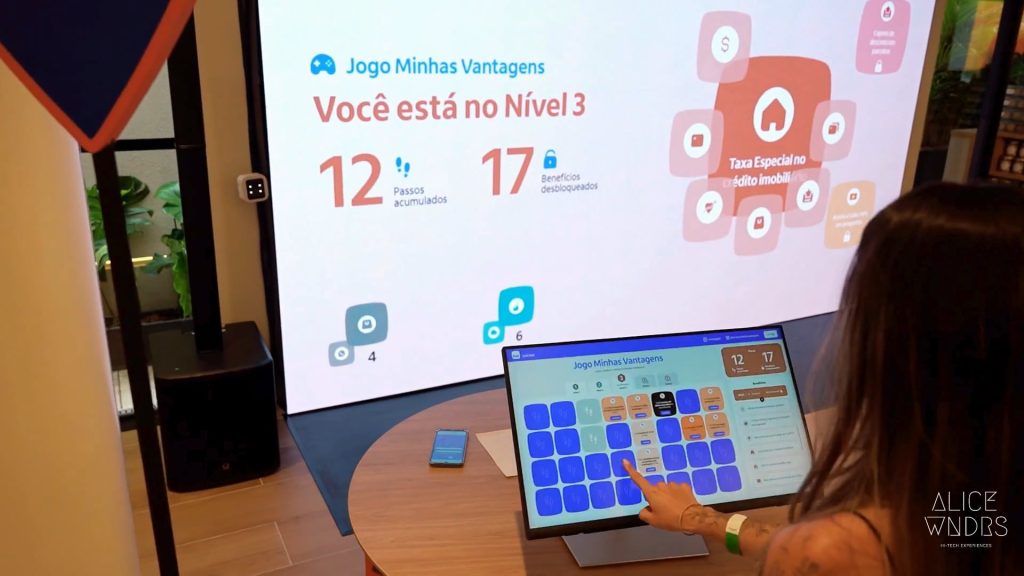
Another approach is to combine digital self-service with access to specialized support right inside the branch. Customers can use kiosks or interactive screens to carry out certain transactions, get guidance from artificial intelligence or, when needed, be connected to a specialist via video call.
This combination preserves the convenience of digital without eliminating the human factor. Customers have the autonomy to handle simple matters, but can quickly reach a professional when the situation calls for more personalized guidance.
In this way, the branch is no longer just a service point and becomes a bridge between technology and human relationships, offering different levels of autonomy and support within a single journey.
AW bringing together the best of both worlds
By combining experience design, technology, content, and strategy, Alice Wonders creates journeys that bring the digital and physical worlds closer together, not as independent channels, but as parts of a single experience.
Whether through interactive environments, immersive experiences, personalized journeys, or solutions that connect physical spaces to digital channels, the goal is to create Phygital experiences that reduce friction, foster relationships, and put the customer at the center of the journey.
More than bringing technology into the branch, it’s about rethinking the role of physical space in the relationship between brands and people. Alice Wonders turns technology into experience and physical spaces into points of connection between brands, people, and possibilities.
Want to learn how to transform bank branches and other physical spaces into consumer experience hubs? Click here and get in touch with us!
Inscreva-se em nossa Newsletter
Receba no seu email todas as novidades do nosso blog sobre tecnologia e varejo, além de ficar por dentro do novos projetos Alice Wonders.
Thank you for subscribing.
Something went wrong.
Respeitamos sua privacidade e levamos a sério a sua proteção