Regardless of which retail sector your company operates in, it probably has to face several strong competitors to hold on to its market share, right?
One strategy that can help you with this task is investing in the customer shopping experience, which can be done in partnership with distributors through effective trade marketing techniques.
In today’s post, in addition to learning why in-store activations matter, you’ll discover 4 apps that will help you measure the results of POS activations. Check it out!
Why run POS activations?
Even if there are intermediaries standing between your product and the end customer, it’s very important for your brand to be present at that moment. After all, no one cares more about your product’s sales than you do.
Not even distributors, since they also carry other products and other brands and, as a result, don’t depend all that much on your success.
POS activations exist to fill exactly that gap. Through them, your brand strengthens its relationship with customers, going from just another option on the shelf to the product they trust.
Keep in mind that the POS is also the final point of the purchase decision. So it can’t be ignored in your strategy.
That’s why it’s essential to have effective trade marketing approaches to strengthen your brand through a closer relationship with the customer, which lets you maximize sales of your product.
How to measure the results of POS activations?
Since you’re looking to increase sales by strengthening your brand, the real measure of effectiveness isn’t sales themselves, but rather the growth in brand reach and the development of a relationship of trust with the end customer.
So, to evaluate the results of POS activations, you need to collect a broader set of data, not just the total number of items sold. By doing this, you can truly discover what those results mean.
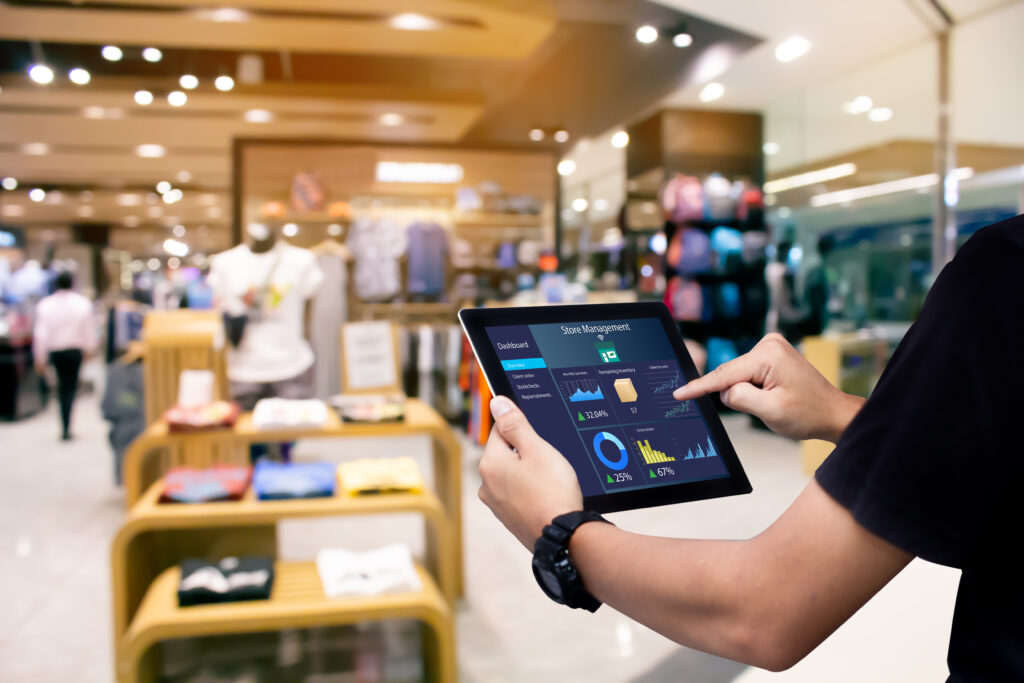
Since there’s nothing better than software for building and analyzing databases, below we present 4 apps that can help you measure the results of POS activations. Take a look:
1. Collect
Collect is one of mobLee’s apps focused on building databases at events. Its role is to serve as an exhibitor tool for collecting customer information in a smart way.
Collect lets you consolidate the contacts gathered by your team, assess the quality of those contacts, and track data such as each team member’s contribution, the amount of data generated on each day of the event, and the average performance of other exhibitors.
Instead of collecting this data in a disorganized, unproductive way by filling out paper sign-up forms by hand, this app lets you gather your company’s most important consumer information for a better evaluation of the results of your presence at the event.
When it comes to trade shows, your company’s main focus goes far beyond increasing sales. In fact, it should be establishing a presence in the market, learning about competitors’ strategies and, above all, building customer loyalty.
In that sense, it’s essential to have a channel for getting in touch with these customers. This feature makes it possible to build a more engaged relationship with them, increasing the number of consumers committed to your business.
2. SigoTrade
While Collect focuses on events and trade shows, SigoTrade is geared toward day-to-day retail: tracking your product on distributors’ shelves. It’s a valuable tool for your in-store merchandisers at the POS and also lets you stay on top of your team’s work.
Merchandisers will use SigoTrade to collect information on pricing, inventory, and out-of-stocks at each distributor. You can then export all of it into custom spreadsheets that you can check in real time, plus, of course, photos of your product at each POS.
It’s worth remembering that being agile with this kind of control is very important, since poor inventory management and letting stockouts happen means missing the chance to sell more — no wonder it’s one of the biggest mistakes in retail.
You’ll also receive information such as each team member’s location and their check-in, check-out, and lunch times. This allows for complete evaluations of each employee.
3. CompTrade
Like SigoTrade, CompTrade also lets you monitor your team of merchandisers at points of sale and collect data on activations.
In addition, it comes with a team of Compart analysts who compare the collected data against successful practices in the retail market and generate reports on it.
The information generated by CompTrade’s data analysis will serve as the basis for decision-making and possible changes to your business’s marketing strategy.
4. Trade Force
With features similar to those of SigoTrade and CompTrade, Trade Force also helps you keep track of your team of trade marketing merchandisers.
What sets Trade Force apart from the other apps is that it lets you run incentive campaigns for your team based on winning new space and materials at the POS, helps you monitor your business’s market share, and tracks competitor information daily.
Given the features of these apps, it’s clear that digital technologies have a lot to offer anyone who wants to innovate in retail. In this case, the role of apps lies mainly in building efficient databases to monitor your trade marketing strategies and measure the results of in-store activations.
The POS is becoming a place for relationships and experiences. So, since it’s still the final point of the purchase decision, it also becomes the perfect place to increase consumer engagement with your brand.
We hope today’s trade marketing app tips help you measure the results of POS activations more effectively!
If you want to learn more about how digital technologies can be useful in retail, follow us on social media so you don’t miss any updates. We’re on Facebook, Instagram, LinkedIn, and Twitter!
Inscreva-se em nossa Newsletter
Receba no seu email todas as novidades do nosso blog sobre tecnologia e varejo, além de ficar por dentro do novos projetos Alice Wonders.
Thank you for subscribing.
Something went wrong.
Respeitamos sua privacidade e levamos a sério a sua proteção