Retail Design That Drives Emotional Impact and Customer Loyalty Comments Off on Retail Design That Drives Emotional Impact and Customer Loyalty 826

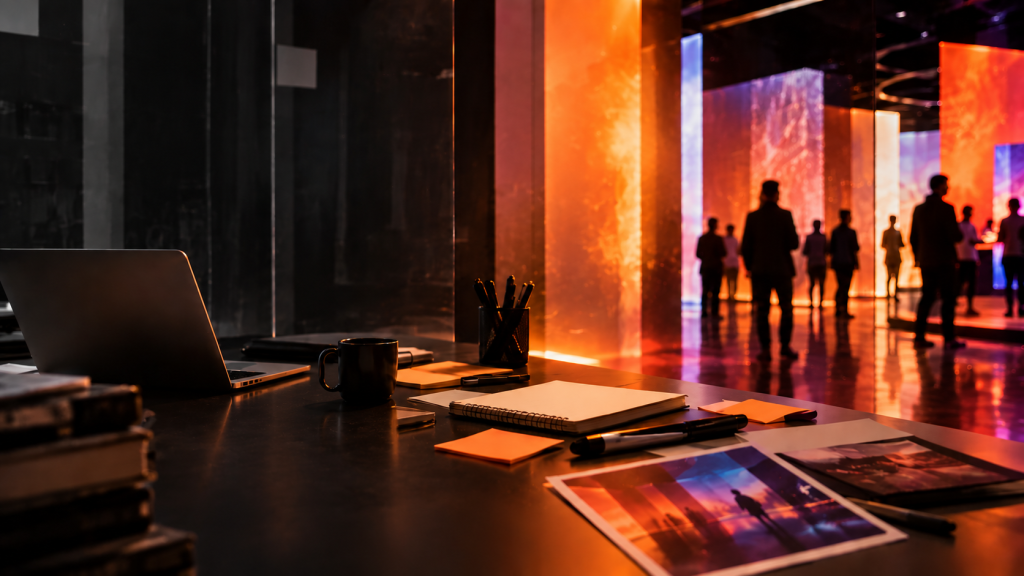
retail design in physical store experience

In today’s retail landscape, retail design is no longer just an aesthetic element; it now plays a strategic role in shaping the consumer experience. Every detail of the environment — lighting, layout, materials, and atmosphere — directly influences brand perception and purchase decisions.

That’s why retail design has become a strategic tool for shaping the in-store brand experience and directly influencing how consumers perceive and feel about a business, to the point of making a purchase decision.

Consumer emotions are directly tied to their experience with a brand and their purchase decisions. A study by Harvard Business School professor Gerald Zaltman and other experts revealed that 85% to 95% of purchase decisions are driven by unconscious and emotional factors.

This shows that focusing on creating emotional impact in brick-and-mortar retail builds customer loyalty, not only because customers will want to buy something, but because they will also be connecting with the emotion and narrative carefully crafted to deliver a unique experience to them.

When well planned, the physical environment reinforces key brand attributes. A minimalist, tech-forward store, for example, can convey innovation and modernity, while a warmer, more sensory space can reinforce closeness and care.

This alignment between identity and space strengthens the customer experience in retail, creating consistency between what the brand communicates and what the consumer experiences. By observing how consumers behave and interact with the space, brands can adjust elements of the environment, test new experiences, and create more relevant journeys.

In this way, design stops being merely an aesthetic tool and starts working as a dynamic system of communication and learning. The result is an in-store brand experience that is better aligned with audience expectations, capable of strengthening brand perception and creating longer-lasting emotional connections.

Retail design: how strategic layout guides the journey

Strategic layout is one of the pillars of retail design, as it determines how consumers move through the space, interact with products, and build their experience inside the store. Far beyond the physical organization of the environment, layout works as a silent mechanism that guides customers along the shopping journey.

When well structured, it helps improve the retail customer experience, increase dwell time, and expand conversion opportunities. Below, we’ve selected some actions that can be applied in brick-and-mortar retail and that directly impact the store layout and the consumer experience:

Strategic product placement

Where products are placed within the store has a direct impact on shopping behavior. Higher-margin items or new launches are usually positioned in high-visibility areas, while complementary products can be grouped together to encourage bundled purchases.

This kind of organization may seem trivial, but it’s underestimated: this simple action can turn the physical space into a business ally, helping optimize results without compromising the consumer experience.

Creating focal points

Visual elements such as in-store showcases, special displays, and scenographic areas act as points of attraction within the store. They help create pauses in the customer journey and draw attention to specific products or campaigns.

Beyond conveying a narrative of the brand embracing and keeping pace with technology in physical spaces, these focal points also help make the visit more memorable, strengthening store design for customer loyalty.

Applying the Brand Ship Store

When we talk about retail design and how it impacts the consumer journey and experience, we can’t overlook an important evolution of this concept: the Brand Ship Store, a store model that goes beyond the traditional flagship.

In this format, the space is conceived as a complete experience platform, where design, technology, services, and content come together to express the brand’s universe. In these stores, the layout is no longer just functional; it becomes narrative.

Themed environments, interactive areas, and social spaces help turn the visit into an immersive experience, reinforcing the in-store brand experience and creating deeper connections with the audience.

Retail design for loyalty: from experience to repeat visits

In today’s retail, making a sale is just the first step. The real challenge lies in turning occasional shoppers into repeat customers and, ideally, into brand advocates. In this process, retail design plays a strategic role by creating experiences capable of building an emotional bond with the audience.

The retail customer experience is influenced by many factors, from the store’s atmosphere to how easy it is to navigate the space. Well-planned environments reduce friction in the shopping journey, make the visit more enjoyable, and encourage consumers to stay longer.

This extra dwell time increases opportunities to interact with products and strengthens the connection with the brand. More than simply shopping, consumers begin to experience the environment, which helps build a more meaningful in-store brand experience.

Another important aspect is the consistency of the experience: when store design clearly reflects the brand’s identity, consumers perceive consistency between what the brand says and what it does. This consistency reinforces trust, an essential factor for loyalty.

In addition, environments that offer positive experiences tend to encourage customers to return on their own. Stores that provide comfort, inspiration, and easy navigation create the right conditions for visits to become a habit. Over time, this repeat behavior strengthens the relationship between brand and consumer.

That’s why store design for customer loyalty needs to be approached strategically, taking into account both functional and emotional aspects. Elements such as appropriate lighting, intuitive product organization, and spaces that encourage exploration all help create a seamless, engaging experience.

When design manages to balance commercial efficiency and emotional experience, the physical space stops being just a sales channel and becomes a point of connection with the audience. This relationship, built across different interactions, is what sustains loyalty and drives long-term brand growth.

The future of retail design

As consumer behavior evolves, the role of the physical store is changing too. In today’s landscape, stores are becoming spaces for gathering, experimentation, and relationship-building.

This shift broadens the role of retail design, which now brings together elements of experience, technology, and lifestyle. One of the trends that illustrates this transformation is the concept of Store Living.

In this model, the store is conceived as a living, multifunctional space where different activities happen at the same time. Beyond selling products, the environment can include lounge areas, events, services, and interactive experiences.

This format strengthens the customer experience in retail by expanding the opportunities to interact with the brand. Shoppers don’t visit the space just to buy, but also to take part in activities, discover what’s new, and connect with the brand’s world.

Store Living also helps increase dwell time, a key factor in strengthening the brand experience at the point of sale. The longer shoppers stay in the space, the more opportunities they have to interact with products, content, and other people.

Another highly relevant aspect is the integration of technology and the physical experience. Digital features, interactive screens, and personalization tools make it possible to tailor the customer journey inside the store, making the experience more dynamic and relevant.

In this context, a strategic store layout remains essential for organizing these multiple functions within the space. Combining sales areas, lounge zones, and interactive experiences requires careful planning to ensure a seamless shopper journey.

At the same time, store design for customer loyalty takes on a new dimension. Instead of focusing solely on immediate conversion, the space is designed as an environment that can foster relationships, a sense of belonging, and ongoing engagement.

This evolution points to a future in which physical stores play an increasingly important role in building brand experiences. More than points of sale, they are becoming platforms that connect brands and people.

Inscreva-se em nossa Newsletter

Receba no seu email todas as novidades do nosso blog sobre tecnologia e varejo, além de ficar por dentro do novos projetos Alice Wonders.

Thank you for subscribing.

Something went wrong.

Previous ArticleNext Article

The Briefing That Kills a Great Experience 0 89

Briefing estratégico para desenvolvimento de experiências de marca

“We need a campaign.” “Let’s do an event.” “We need an activation.” “How about building an app?” Almost all of these requests share the same first step: the brief.

In day-to-day marketing, phrases like these tend to show up as the starting point for new projects. The problem is that, more often than not, they don’t present the challenge. They already present the answer.

And when the solution comes before the problem, creativity starts out with less room to explore.

That doesn’t mean a campaign, an event or an activation is a bad choice. The real question is whether it is, in fact, the best answer to what the company needs to transform. After all, it’s entirely possible to execute a solution perfectly and still solve the wrong problem.

Before the “what,” comes the “why”

An effective brief shouldn’t start with the deliverable. It should start with the context.

  • What’s happening?;
  • Why does it matter to the business?; 
  • Who is affected?;
  • What is that person going through?;
  • Is there a behavior or perception that needs to change?;
  • What has already been tried?;
  • And what don’t we know yet about this challenge?

These questions help turn a request into an opportunity for investigation.

“We need to create an activation to increase store traffic,” for example, already defines a big part of the path. But realizing that a significant number of people move through the space without engaging with a particular category opens up a far more interesting discussion: how can we make this journey more relevant?

An activation may still be the answer. But now it’s one possibility among many — not a decision made before the problem was understood.

A good brief opens up possibilities

There’s an important difference between giving direction and dictating the solution. A good brief needs to be clear about the challenge, the audience, the objectives, the context and the constraints. At the same time, it should leave room for the team to question assumptions and explore different paths.

It’s precisely this combination that can make the creative process more powerful.

When the brief says “do X to achieve Y,” the discussion tends to focus on how to do X as well as possible. When it says “we need to achieve Y because this is the scenario we’re facing,” the question becomes “what’s the best way to get there?”

It may seem like a small difference, but it can completely change the outcome.

The solution might lie in a physical experience, in content, technology, service, communication, environment, journey or a combination of different possibilities. The format stops being the starting point and becomes a consequence of the strategy.

So where does experience come in?

With whoever is on the other side.

A good experience doesn’t come only from what the brand wants to communicate or offer. It needs to take into account the context of the people who will live it. What do they expect? What could create friction? What’s relevant at that moment? What role does the brand play in that journey?

When these questions make it into the brief, the project stops being just about a deliverable and becomes about a transformation.

This perspective also helps avoid one of the most common mistakes in experience projects: creating something interesting for the company but not very relevant to people.

An idea can be beautiful, innovative and technically flawless. But if it doesn’t respond to a real need or doesn’t make sense in that context, it’s unlikely to be a good experience.

The brief doesn’t need to come with a ready-made idea

Perhaps this is the main shift in perspective: the brief isn’t there to say exactly what should be created. It’s there to create the conditions for the best idea to emerge.

That means spending more time understanding the problem before rushing to the solution. It means questioning requests, investigating behaviors, acknowledging constraints and leaving room for possibilities that weren’t on the radar yet.

In the end, the more clarity there is about the problem, the more freedom there is to think about the solution.

This is the mindset Alice Wonders brings to turning business challenges into experiences. Combining strategy, creativity and a people-centered approach, we help brands break away from ready-made solutions and find more relevant paths for what truly needs to be transformed.

Because a good experience may start with an idea. But a relevant experience starts with a good question.

Want to uncover new possibilities for one of your brand’s challenges? Talk to Alice Wonders.

Inscreva-se em nossa Newsletter

Receba no seu email todas as novidades do nosso blog sobre tecnologia e varejo, além de ficar por dentro do novos projetos Alice Wonders.

Thank you for subscribing.

Something went wrong.

In the Age of AI, What Still Needs to Be Human? 0 92

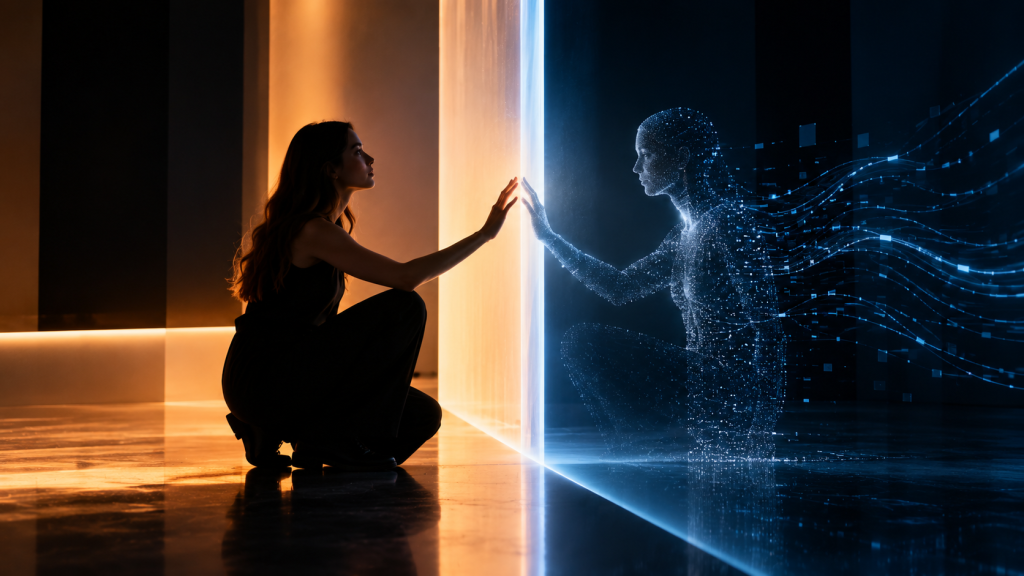
Experiência imersiva que representa a conexão entre inteligência artificial e fator humano.

You know when you chat with an AI chatbot, get exactly the information you needed, and still feel like something was missing? Or when an AI-generated image is technically perfect but doesn’t stir any emotion at all?

These examples point to one of the biggest challenges of the AI era: the more technology we have at our disposal, the more valuable the traits that are still essentially human become.

Artificial intelligence already writes, creates images, analyzes data, personalizes content and automates processes. But with so many possibilities, a question arises: if technology can do more and more for us, what still needs to be done by people?

With that in mind, today we’ll look at what still needs to be human, even in the AI era, and how to get there without competing with technology, but by using it as a business ally. Enjoy the read!

AI has changed the game

To start, we need to understand that artificial intelligence has brought speed, scale and efficiency to companies in virtually every industry. Today, brands can analyze behavior, personalize journeys, generate content and automate interactions in a matter of seconds.

The problem is that when the same tools are available to everyone, technology alone stops being a differentiator. If any brand can use AI to personalize a message, generate an image or automate customer service, what will make one of them memorable?

That’s where the human factor comes in. AI can identify patterns, but interpreting context is another story. It can recognize emotions, but not experience them. It can generate possibilities, but it can’t decide on its own which of them actually makes sense for a brand. It can personalize an interaction, but it doesn’t necessarily create a connection.

In the end, memorable experiences are built on something that goes beyond technology: feeling, meaning and identification.

What still needs to be human?

Now that we understand how AI operates and how it can support a business, the question remains: what still needs to be human? So we’ve put together a few areas below where AI can’t perform as well as a human. Take a look:  

  • Feeling: an AI can identify that a certain experience has the potential to move people. But it’s the person who feels surprise, nostalgia, belonging or delight. And it’s these emotions that turn an interaction into a memory;
  • Interpreting: data shows what people do. But understanding why they do it takes context, background and sensitivity;
  • Creating meaning: artificial intelligence can generate thousands of ideas. But an experience doesn’t become relevant just because it’s new. It needs purpose, it needs to align with the brand and it needs to make sense for whoever is living that moment.
  • Building connections: an unexpected detail, service that shows genuine care or an experience that feels designed especially for someone can create bonds that go far beyond the transaction. And the more automated our relationships become, the more value there may be in precisely these genuinely human moments.

What if AI made experiences more human?

Is there an ideal world where technology and human experiences support each other in perfect harmony? Well, in brick-and-mortar retail, this discussion becomes even more relevant. Instead of using artificial intelligence just to automate processes, brands can use it to enhance experiences.

Imagine spaces that adapt content to each visitor, experiences that personalize journeys in real time or environments that respond to people’s behavior.

Technology is there, but it doesn’t have to be the star. The star is the person living the experience. That’s why the question shouldn’t just be “where can we add AI?” but rather: “How can AI make this experience more relevant for the people who are here?”

Like other technologies, artificial intelligence is likely to become increasingly accessible. The differentiator, then, won’t be who uses AI, but who knows how to use it with purpose. That means starting with the consumer, understanding their behavior, defining what the brand wants to spark and only then choosing the technology that can make that experience possible.

Because AI can expand possibilities. But it’s the human perspective that turns possibilities into meaning.

AW: technology to create more human experiences

At Alice Wonders, we believe technology only makes sense when there’s a purpose behind it.

That’s why we combine technology, creativity and strategy to transform physical spaces into experiences that bring brands and people closer together.

Want to discover how to use technology to create more human and memorable experiences for your brand?

Click here to learn more about Alice Wonders’ work.

Inscreva-se em nossa Newsletter

Receba no seu email todas as novidades do nosso blog sobre tecnologia e varejo, além de ficar por dentro do novos projetos Alice Wonders.

Thank you for subscribing.

Something went wrong.

Most Popular Topics

Editor Picks

Send this to a friend