Magic Room vs. Magic Floor: Concepts and Differences Comments Off on Magic Room vs. Magic Floor: Concepts and Differences 492

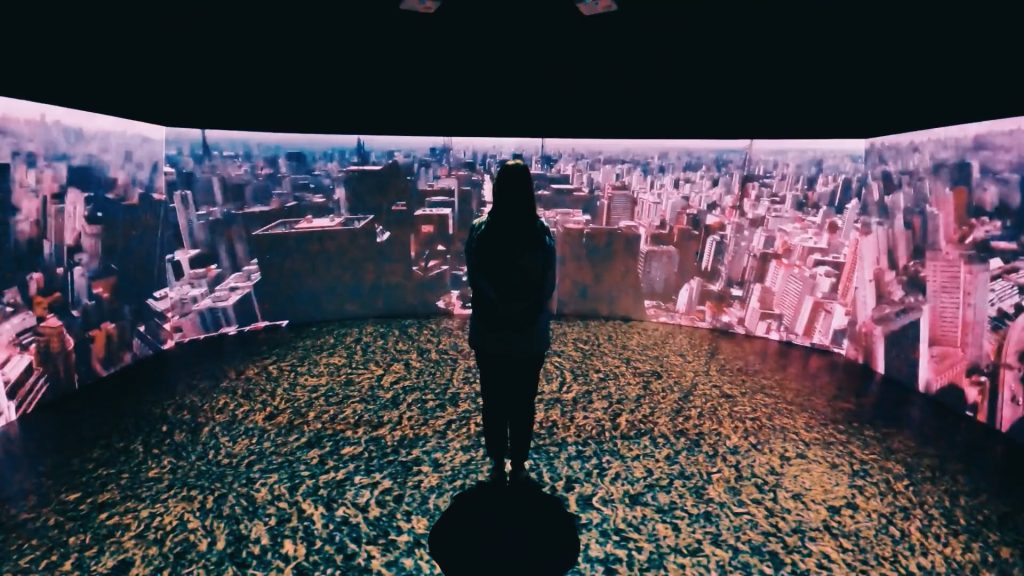
Magic Room com projeções imersivas em ambiente físico

Imagine walking into a space and, within seconds, watching the walls and floors transform into images, stories, and possibilities. That’s what Magic solutions like Magic Room and Magic Floor can deliver: experiences that transform environments through technology.

Although both use digital resources to create immersive experiences, each solution has a different purpose.

But which one should you choose for your project? That’s what we’ll cover in this article. Enjoy the read!

What is an immersive experience?

An immersive experience turns the audience from spectators into participants. Projections, audiovisual content, interactivity, architecture, and storytelling work together to create a more engaging journey.

In practice, this means using technology not just to grab attention, but to make information easier to understand, build connection, and make a message memorable. It’s a strategy that can be applied across sectors such as retail, events, architecture, and real estate.

With that in mind, then…

What is Magic Room?

Magic Room turns a space into an immersive experience. Through projections and audiovisual content, walls, floors, and other surfaces come to life and become part of a story.

The goal is to create an experience that transports the audience into the world of a brand, product, or development. The solution can be used for:

  • Real estate launches;
  • Sales booths;
  • Events;
  • Brand activations;
  • Experiential retail;
  • Experience spaces;
  • Product presentations.

In real estate, for example, a Magic Room can showcase not only the features of a development, but also the lifestyle and atmosphere it aims to convey. Click here to check out Alice Wonders’ Magic Room case with Gran Incorporadora!

What is Magic Floor?

Magic Floor, on the other hand, is a floor that becomes the centerpiece of the experience. The technology turns this surface into a visual and, depending on the project, interactive interface. Floor plans, layouts, information, animations, and all kinds of content can be displayed right on the floor.

One especially compelling application is also in real estate: imagine viewing a floor plan at full scale and walking through the rooms, understanding their dimensions far more intuitively. Possible uses for Magic Floor include:

  • Sales booths;
  • Real estate launches;
  • Floor plan and layout presentations;
  • Events;
  • Brand experiences;
  • Architecture projects;
  • Retail activations.

Alice Wonders and Galeria Laguna recently teamed up on a partnership that produced a Magic Floor success story. Click here to see how this technology works in practice!

Magic Room or Magic Floor: which one should you choose?

So, at the end of the day, which one should you choose? It depends on your project’s goal. If you want to tell a story, make an impact, and transport your audience into your brand’s world, Magic Room may be the best solution.

If, however, the goal is to present floor plans and layouts or let people explore a space more interactively, Magic Floor may make more sense.

And you don’t have to pick just one.

Depending on your strategy, the two solutions can be combined to create a complete journey: first, the audience discovers the concept and the story; then, they explore the space and its possibilities.

That’s why, more important than choosing the most impressive technology, is understanding this: what experience do you want to deliver?

Turn your space into an experience

Whether it’s Magic Room or Magic Floor, both show that physical spaces can go far beyond their traditional role. They can present, engage, interact, and tell stories.

At Alice Wonders, we combine technology, creativity, and strategy to develop custom experiences that turn spaces into points of connection between brands and people.

Because your space doesn’t just have to show. It can make your audience live the experience.

Want to find out which solution is right for your project? Click here and talk to Alice Wonders.

Inscreva-se em nossa Newsletter

Receba no seu email todas as novidades do nosso blog sobre tecnologia e varejo, além de ficar por dentro do novos projetos Alice Wonders.

Thank you for subscribing.

Something went wrong.

Previous ArticleNext Article

The Briefing That Kills a Great Experience 0 88

Briefing estratégico para desenvolvimento de experiências de marca

“We need a campaign.” “Let’s do an event.” “We need an activation.” “How about building an app?” Almost all of these requests share the same first step: the brief.

In day-to-day marketing, phrases like these tend to show up as the starting point for new projects. The problem is that, more often than not, they don’t present the challenge. They already present the answer.

And when the solution comes before the problem, creativity starts out with less room to explore.

That doesn’t mean a campaign, an event or an activation is a bad choice. The real question is whether it is, in fact, the best answer to what the company needs to transform. After all, it’s entirely possible to execute a solution perfectly and still solve the wrong problem.

Before the “what,” comes the “why”

An effective brief shouldn’t start with the deliverable. It should start with the context.

  • What’s happening?;
  • Why does it matter to the business?; 
  • Who is affected?;
  • What is that person going through?;
  • Is there a behavior or perception that needs to change?;
  • What has already been tried?;
  • And what don’t we know yet about this challenge?

These questions help turn a request into an opportunity for investigation.

“We need to create an activation to increase store traffic,” for example, already defines a big part of the path. But realizing that a significant number of people move through the space without engaging with a particular category opens up a far more interesting discussion: how can we make this journey more relevant?

An activation may still be the answer. But now it’s one possibility among many — not a decision made before the problem was understood.

A good brief opens up possibilities

There’s an important difference between giving direction and dictating the solution. A good brief needs to be clear about the challenge, the audience, the objectives, the context and the constraints. At the same time, it should leave room for the team to question assumptions and explore different paths.

It’s precisely this combination that can make the creative process more powerful.

When the brief says “do X to achieve Y,” the discussion tends to focus on how to do X as well as possible. When it says “we need to achieve Y because this is the scenario we’re facing,” the question becomes “what’s the best way to get there?”

It may seem like a small difference, but it can completely change the outcome.

The solution might lie in a physical experience, in content, technology, service, communication, environment, journey or a combination of different possibilities. The format stops being the starting point and becomes a consequence of the strategy.

So where does experience come in?

With whoever is on the other side.

A good experience doesn’t come only from what the brand wants to communicate or offer. It needs to take into account the context of the people who will live it. What do they expect? What could create friction? What’s relevant at that moment? What role does the brand play in that journey?

When these questions make it into the brief, the project stops being just about a deliverable and becomes about a transformation.

This perspective also helps avoid one of the most common mistakes in experience projects: creating something interesting for the company but not very relevant to people.

An idea can be beautiful, innovative and technically flawless. But if it doesn’t respond to a real need or doesn’t make sense in that context, it’s unlikely to be a good experience.

The brief doesn’t need to come with a ready-made idea

Perhaps this is the main shift in perspective: the brief isn’t there to say exactly what should be created. It’s there to create the conditions for the best idea to emerge.

That means spending more time understanding the problem before rushing to the solution. It means questioning requests, investigating behaviors, acknowledging constraints and leaving room for possibilities that weren’t on the radar yet.

In the end, the more clarity there is about the problem, the more freedom there is to think about the solution.

This is the mindset Alice Wonders brings to turning business challenges into experiences. Combining strategy, creativity and a people-centered approach, we help brands break away from ready-made solutions and find more relevant paths for what truly needs to be transformed.

Because a good experience may start with an idea. But a relevant experience starts with a good question.

Want to uncover new possibilities for one of your brand’s challenges? Talk to Alice Wonders.

Inscreva-se em nossa Newsletter

Receba no seu email todas as novidades do nosso blog sobre tecnologia e varejo, além de ficar por dentro do novos projetos Alice Wonders.

Thank you for subscribing.

Something went wrong.

In the Age of AI, What Still Needs to Be Human? 0 92

Experiência imersiva que representa a conexão entre inteligência artificial e fator humano.

You know when you chat with an AI chatbot, get exactly the information you needed, and still feel like something was missing? Or when an AI-generated image is technically perfect but doesn’t stir any emotion at all?

These examples point to one of the biggest challenges of the AI era: the more technology we have at our disposal, the more valuable the traits that are still essentially human become.

Artificial intelligence already writes, creates images, analyzes data, personalizes content and automates processes. But with so many possibilities, a question arises: if technology can do more and more for us, what still needs to be done by people?

With that in mind, today we’ll look at what still needs to be human, even in the AI era, and how to get there without competing with technology, but by using it as a business ally. Enjoy the read!

AI has changed the game

To start, we need to understand that artificial intelligence has brought speed, scale and efficiency to companies in virtually every industry. Today, brands can analyze behavior, personalize journeys, generate content and automate interactions in a matter of seconds.

The problem is that when the same tools are available to everyone, technology alone stops being a differentiator. If any brand can use AI to personalize a message, generate an image or automate customer service, what will make one of them memorable?

That’s where the human factor comes in. AI can identify patterns, but interpreting context is another story. It can recognize emotions, but not experience them. It can generate possibilities, but it can’t decide on its own which of them actually makes sense for a brand. It can personalize an interaction, but it doesn’t necessarily create a connection.

In the end, memorable experiences are built on something that goes beyond technology: feeling, meaning and identification.

What still needs to be human?

Now that we understand how AI operates and how it can support a business, the question remains: what still needs to be human? So we’ve put together a few areas below where AI can’t perform as well as a human. Take a look:  

  • Feeling: an AI can identify that a certain experience has the potential to move people. But it’s the person who feels surprise, nostalgia, belonging or delight. And it’s these emotions that turn an interaction into a memory;
  • Interpreting: data shows what people do. But understanding why they do it takes context, background and sensitivity;
  • Creating meaning: artificial intelligence can generate thousands of ideas. But an experience doesn’t become relevant just because it’s new. It needs purpose, it needs to align with the brand and it needs to make sense for whoever is living that moment.
  • Building connections: an unexpected detail, service that shows genuine care or an experience that feels designed especially for someone can create bonds that go far beyond the transaction. And the more automated our relationships become, the more value there may be in precisely these genuinely human moments.

What if AI made experiences more human?

Is there an ideal world where technology and human experiences support each other in perfect harmony? Well, in brick-and-mortar retail, this discussion becomes even more relevant. Instead of using artificial intelligence just to automate processes, brands can use it to enhance experiences.

Imagine spaces that adapt content to each visitor, experiences that personalize journeys in real time or environments that respond to people’s behavior.

Technology is there, but it doesn’t have to be the star. The star is the person living the experience. That’s why the question shouldn’t just be “where can we add AI?” but rather: “How can AI make this experience more relevant for the people who are here?”

Like other technologies, artificial intelligence is likely to become increasingly accessible. The differentiator, then, won’t be who uses AI, but who knows how to use it with purpose. That means starting with the consumer, understanding their behavior, defining what the brand wants to spark and only then choosing the technology that can make that experience possible.

Because AI can expand possibilities. But it’s the human perspective that turns possibilities into meaning.

AW: technology to create more human experiences

At Alice Wonders, we believe technology only makes sense when there’s a purpose behind it.

That’s why we combine technology, creativity and strategy to transform physical spaces into experiences that bring brands and people closer together.

Want to discover how to use technology to create more human and memorable experiences for your brand?

Click here to learn more about Alice Wonders’ work.

Inscreva-se em nossa Newsletter

Receba no seu email todas as novidades do nosso blog sobre tecnologia e varejo, além de ficar por dentro do novos projetos Alice Wonders.

Thank you for subscribing.

Something went wrong.

Most Popular Topics

Editor Picks

Send this to a friend