Immersive Rooms: Models to Inspire Your Business
Immersive room models are transforming the way businesses interact with their customers. This powerful, innovative trend is opening the door to unique and engaging experiences.
In this article, we’ll explore 04 immersive room models that can revolutionize the way you present your products and services, taking the customer experience to a whole new level.
1. Immersive Rooms with Storytelling
Using storytelling in immersive rooms lets you create a unique, engaging narrative that goes far beyond simply presenting a product.
Imagine being able to tell the story of your product’s origins, its manufacturing process, or even share the core pillars your brand was built on.
For example, you could turn a room in your coffee shop into a space that transports customers to the farm where the coffee is grown, showing the entire process from harvest to cup.
This not only captures customers’ attention but also increases the likelihood of converting sales, since people tend to engage more with brands that tell meaningful stories.
A study published in the Journal of Marketing Research suggests that consumers are more likely to buy products when they are emotionally engaged with the brand (Escalas, Jennifer Edson, and James R. Bettman. “Self-Construal, Reference Groups, and Brand Meaning.” Journal of Consumer Research, 2003).
2. Immersive Rooms with Projection Mapping
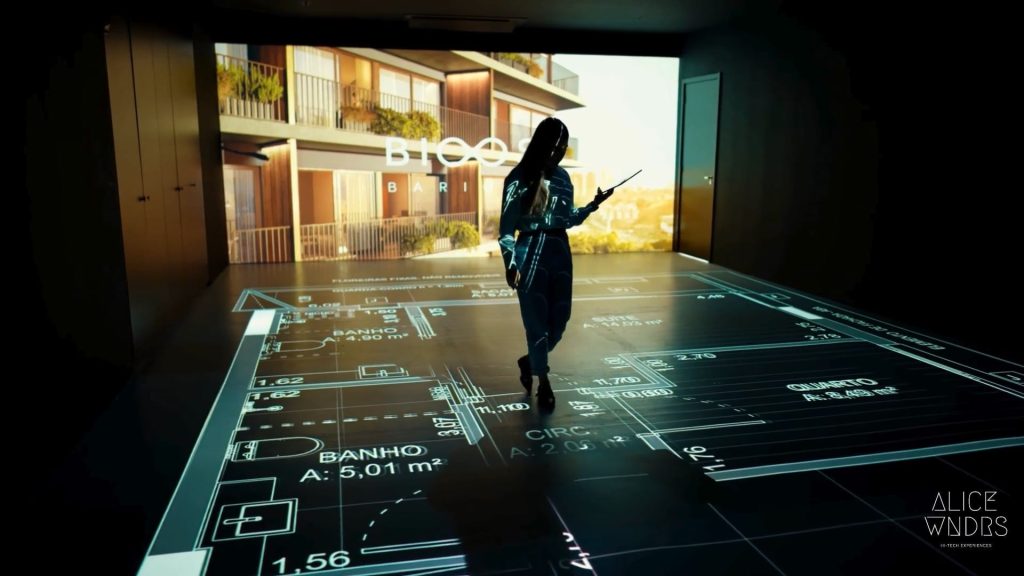
Projection mapping in immersive rooms is an innovative approach that lets you completely transform the space, creating an impressive visual and tactile experience.
With this technology, the room’s surfaces come to life, allowing you to project different scenes, textures, or information about your services or products.
Imagine, for example, showcasing a car’s technical specs by projecting them directly onto the vehicle in your dealership, letting customers see and interact with the information in a unique way.
You can combine storytelling and projection mapping to create unique, immersive experiences for your customers. Take a look at the project we delivered for real estate developer Gafisa. The result? 100% of the units sold in 3 months.
Immersive Room Case Study with Projection Mapping and Storytelling
With testimonials from former residents, projection mapping that brought the scale models to life, and sensors that recognized books and told stories, the outcome couldn’t have been any different: 80% of the apartments at Square Ipiranga Gafisa were sold in just 5 weeks.
3. Immersive Rooms with Multisensory Immersion
Multisensory immersion in immersive rooms is a way to connect with your customers on a deeper level, engaging not just sight but all the other senses as well: hearing, smell, and touch.
This allows you to offer a complete, engaging experience.
Imagine, for example, a fragrance store that not only shows off its packaging design but also lets customers smell each perfume.
Or a fabric store where customers can touch and feel different textures while listening to detailed explanations about each material.
See below how we put this into practice for Dior:
Immersive Room Case Study with Multisensory Immersion
For an enchanting, multisensory immersion in the Dior space at Hotel Sephora, Alice Wonders developed projection mapping that brought to life the launch of J’adore Eau de Parfum, the brand’s newest fragrance.
The Instagrammable space gained notoriety and organic posts on the social media accounts of celebrities such as Carolina Dieckmann, Preta Gil, Livia Aragão (and more!).
4. Immersive Rooms with Interactivity and Insights
Implementing immersive rooms with interactivity and insight generation takes the customer experience to a new level, allowing you to engage your customers more actively.
Imagine a room where customers can explore different variations of a product, switch colors and models, or even see how a piece of furniture would look in their home. All of this happens in an interactive, personalized way.
As customers interact, you have the opportunity to collect valuable data about their preferences, tastes, and behaviors. This information is crucial for understanding what truly resonates with your target audience, allowing you to adjust and optimize your sales and marketing strategy.
Immersive Room Case Study with Interactivity and Insights
The immersive room proved to be a valuable source of data and insights for the developer. With Decorado 4D, MPD found that 75% of its customers had a modern profile, compared to 25% with a classic profile. With that, the developer was able to restructure its marketing and business strategies.
Conclusion
Immersive room models are establishing themselves as a true revolution in retail, opening the door to innovative and memorable experiences.
Whether through engaging narratives, projection mapping, or multisensory immersion, you have powerful tools at your fingertips to transform your relationship with your customers.
Choosing the model that best aligns with your brand and goals takes your business to new heights, setting you apart in an increasingly competitive market.
Implementing these technologies isn’t just a competitive edge; it’s a step toward the future of retail, where the customer experience is personalized, enriching, and data-driven.
The time to explore these opportunities is now. The revolution has already begun, and you’re invited to be part of it.
Get in touch:
WhatsApp: (11) 98818-0492
Email: chapeleiro@alicewonders.ws
FAQ (Frequently Asked Questions)
What are immersive rooms? Immersive rooms are spaces equipped with advanced technology that makes it possible to create unique, engaging experiences by simulating a wide range of environments and sensations. In retail, they can be used to showcase products and services in innovative ways.
How do immersive rooms with storytelling work? Immersive rooms with storytelling use narratives to engage customers, telling stories about a product’s origin, its manufacturing process, or a narrative that aligns with the brand.
What does projection mapping mean in immersive rooms? Projection mapping in immersive rooms turns surfaces into “screens.” You can display different settings, textures, or product information, offering a unique visual and tactile experience that goes beyond conventional presentation.
How can multisensory immersion be applied? Multisensory immersion engages all the senses: sight, hearing, smell, and touch. This lets customers smell the scent, touch the texture, or hear the sound of a product or environment, giving them a deeper, more complete understanding.
How do interactivity and insight generation benefit retail? This combination allows customers to become active participants, virtually trying out variations of a product or service. At the same time, you can collect data on preferences and behaviors, fine-tuning your sales strategy and optimizing future interactions.
Meet Granometrics.io
Alice Wonders’ Granometrics.io platform is an exclusive tool that uses multiple sensors to map the physical store and deliver valuable insights for decision-making.
With it, you can get all the information you need to optimize your POS and boost your sales, such as data on:
- In-store traffic;
- Interaction time
- Peak hours, days of the week, and days of the month.
- Preferences
What about you, brand or retailer: do you really know your audience? And how your store is performing?
Be sure to get in touch with us and schedule a Granometrics.io demo.
Inscreva-se em nossa Newsletter
Receba no seu email todas as novidades do nosso blog sobre tecnologia e varejo, além de ficar por dentro do novos projetos Alice Wonders.
Thank you for subscribing.
Something went wrong.
Respeitamos sua privacidade e levamos a sério a sua proteção