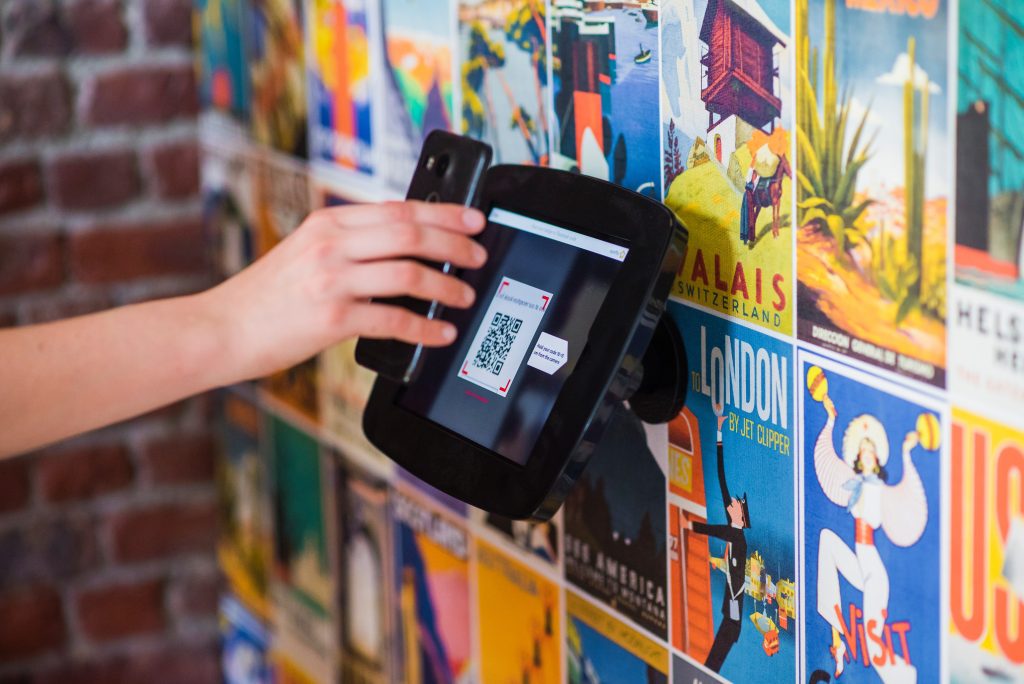
The QR Code isn’t exactly a new technology, but that doesn’t mean it isn’t modern. Even though it has been around for quite a while, it has never seen as much adoption as it does today. In retail, there are many ways to use this technology to create better experiences and drive strategically planned interactions.
Your customers are willing to share the information you want and engage with your marketing initiatives, as long as it’s worth their while, of course. With that in mind, QR Codes can be the bridge between your audience’s willingness and the conversion opportunity your business has designed. You just need to know how to use the tool.
To help out, we’ve put together some great options that are not only effective but also easy to implement in brick-and-mortar retail. Check out the 7 best ways to use this tool and see what each one is good for.

1. Promote your sales and discounts
Shoppers never stop looking for special deals on the products they want to buy. Even if a particular item wasn’t on their radar, a good discount, for example, can change everything.
So you need to make these offers easy to access, ideally by creating a landing page your customers reach after scanning a QR Code. You can also point the code to a sales section on your e-commerce site.
Ideally, place these QR Codes that lead to your brand’s offers in a few strategic locations, such as advertising kiosks around the city or in malls. It’s also a great idea to display the code, with a CTA announcing the deals, inside your own physical store.

2. Offer additional and complementary content
Good content strategies can deliver all kinds of benefits to your business. This is a win-win: while your customers get access to quality content, you get the chance to drive engagement and generate leads.
The QR Code connects interested customers to content that might live on your blog, your website, your company’s YouTube channel, or even your brand’s social media. It’s essential, however, that this content be presented in an engaging way that sparks the customer’s interest.
Display this QR Code at your POS, always with CTAs inviting your customers to learn more about a topic, discover a new product, or take part in some other experience. This call to action should be related to the content the person will be redirected to.

3. Use it as a lead capture tool
You’ve surely come across CTAs like “Sign up so you never miss a sale or product launch.” This kind of strategy lets you capture a customer’s contact information and, in doing so, gain a lead that can turn into purchases down the road.
This type of messaging is very common online, but you can also apply it in brick-and-mortar retail, of course, using a QR Code. The idea is for the code to redirect people to a landing page with a form where they’ll fill in their details.
But remember: follow-through is essential. If you set out to capture leads in your physical store, you need to nurture your contact list with offers and content and stay in constant touch. That’s how you’ll win engagement and conversions.

4. Offer a new payment method
Your customers most likely hate standing in long lines at your point of sale. So your retail strategy should include payment methods that avoid this problem. Self-checkout is one of the main ones, and it can be done with the help of QR Codes.
Using service kiosks or spots throughout the store, place codes that customers can scan to go straight to a checkout page. That way, people skip the line and the in-store experience is far more satisfying.
For this to work, remember that product packaging or item tags need to have a QR Code with product information and price. That way, customers can scan each product themselves and, at the end, pay directly from their smartphones.

5. Ask customers to rate their experience
A good retail experience will motivate your customers to rate your business positively. So it’s a great idea to place prompts in a few spots around your store encouraging people to rate the store and their shopping experience.
To do this, use QR Codes that direct customers to review pages. There, you can use whatever approach you like, such as an NPS survey. If possible, also allow additional written comments along with the rating.
As useful as this feature is, keep in mind that it may also generate less-than-positive feedback. If the in-store experience isn’t great, your customers will say so. Either way, negative feedback can be very valuable as a foundation for planning improvements.

6. Link to your social media
Every self-respecting brand is looking to drive solid consumer traffic to its social media channels. That’s surely the case for your company too, so using QR Codes to attract more followers is highly recommended.
People who are happy with their shopping experience at a POS are more likely to want to stay close to your brand. Today, social media is what makes this possible most easily, and in the way audiences like best.
So don’t forget to invite your store’s shoppers to follow the company on the social networks where the brand is present. Do this with a code placed at strategic spots throughout the store that redirects to those profiles.
QR Codes at the POS can play a truly interesting role, even though they’re a simple technology. Their convenience and the possibilities they open up make them practically a must for creating great opportunities.
Enjoyed learning more about this topic? Subscribe to our Newsletter and get the latest news and trends from the world of Technology, Innovation & Retail!
Inscreva-se em nossa Newsletter
Receba no seu email todas as novidades do nosso blog sobre tecnologia e varejo, além de ficar por dentro do novos projetos Alice Wonders.