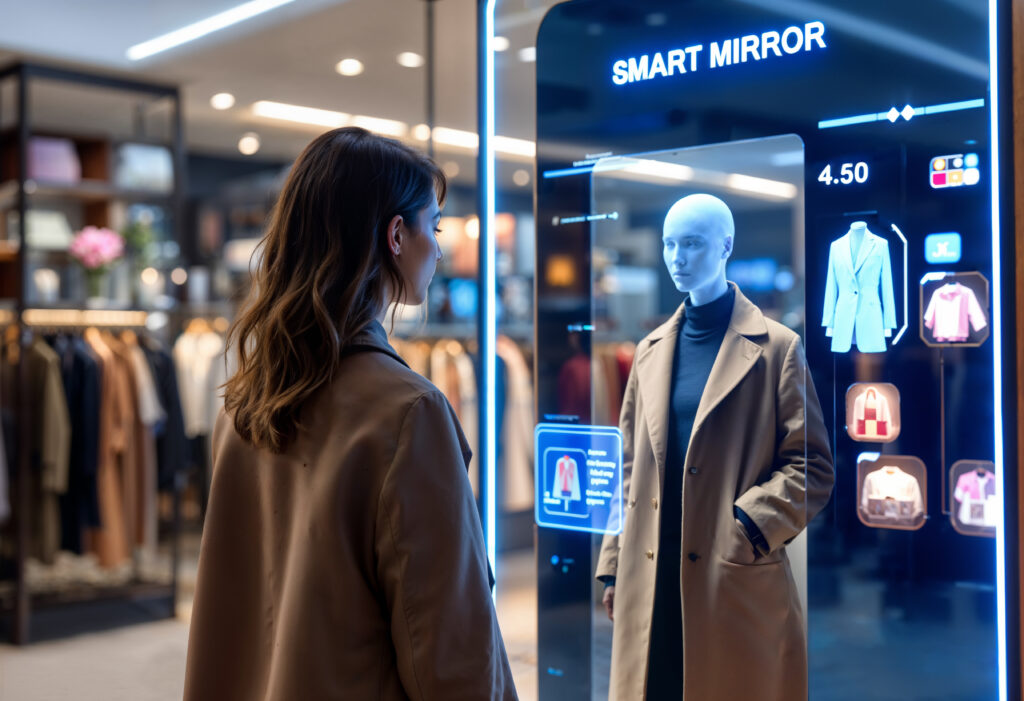
The use of AI-powered POS is transforming the way consumers interact with brands in physical retail. Accustomed to personalized digital experiences, shoppers now expect the same level of relevance and convenience inside stores.
In this landscape, retail personalization is no longer just a trend. It has become a key competitive differentiator for companies that want to stand out, especially at physical points of sale.
With the advance of artificial intelligence across the market, retail included, it has become possible to analyze data, identify behavior patterns, and adapt interactions in real time inside stores.
By integrating these solutions into AI-powered POS, retailers can create more relevant experiences that align with each consumer’s interests and needs.
This evolution marks the rise of so-called smart retail, in which data, technology, and consumer behavior connect to continuously improve the retail customer experience and deliver more measurable business results.
How AI-powered POS enables real-time personalization
It’s no news to anyone that Artificial Intelligence has completely changed the world, society, and even the market, becoming a powerful ally for those who want to walk hand in hand with technology.
When it comes to physical retail, the picture is no different. Proof of this is a 2025 survey by CNDL (Brazil’s National Confederation of Store Managers), which shows that 41% of business owners believe AI can be an important way to increase companies’ competitiveness in the coming years.
That’s because the use of technology at the point of sale (POS) has allowed physical stores to adopt retail personalization strategies that were once limited to the digital environment. By analyzing data and recognizing behavior patterns, AI can identify consumer preferences, interests, and interactions within the physical space.
When integrated with point-of-sale (POS) technology, artificial intelligence can interpret information such as foot traffic, dwell time in certain areas of the store, and interaction with products or digital content.
This data helps build a better understanding of consumer behavior and makes it possible to adjust messages, offers, and experiences in real time. And we all know that, in today’s world, having access to high-quality, well-organized data makes all the difference in decision-making.
This kind of approach is part of the shift toward smart retail, in which the store becomes a connected, responsive environment. As a result, brands can deliver a retail customer experience that is smoother, more relevant, and aligned with the expectations of increasingly digital consumers.
AI-powered POS strategies that work in retail
Applying technology at the point of sale (POS) in retail has nothing to do with the stereotypical image of a robot wandering back and forth inside a brick-and-mortar store. Quite the opposite: it can be implemented in a subtle and highly useful way within a physical space.
With the support of AI-powered POS, retailers can adapt content, offers, and interactions to the profile of the audience in the space, making the journey more consistent and effortless for the end consumer.
To better understand this, below are some AI-driven personalization strategies in retail that brands are already using to enhance the retail customer experience and strengthen smart retail initiatives.
Behavior-based product recommendations
One of the most common applications of artificial intelligence in retail is product recommendations based on consumer behavior. This happens through the analysis of data such as:
- Purchase history;
- Preferences recorded in brand apps;
- Previous interactions with a given product.
Inside the physical store, these recommendations can appear on digital screens, interactive kiosks, or apps used during the visit to the point of sale. This approach reinforces retail personalization by making the journey more targeted and helping consumers discover relevant products faster.
By pairing technology with AI at the point of sale (POS) to deliver personalized suggestions, brands help improve the retail customer experience and increase the chances of conversion.
Dynamic content and audience-tailored communication
Another relevant strategy involves using dynamic content inside the store. With the support of AI-powered POS, digital screens and visual communication systems can automatically adapt the messages displayed to the profile of the audience present at that moment.
This personalization can take into account factors such as time of day, in-store traffic patterns, or the predominant characteristics of the audience in the space. That way, campaigns, offers, and content are displayed in a more contextualized way.
This approach strengthens retail personalization by making communication more relevant and aligned with the consumer’s context, helping enhance the retail customer experience and consolidate smart retail practices.
Personalized offers and perks at the point of sale
Artificial intelligence in retail also allows brands to offer personalized promotions and perks inside the physical store. By cross-referencing behavioral data, purchase history, and consumer preferences, systems can identify opportunities to present more relevant offers during the in-store journey.
These offers can be communicated through apps, loyalty programs, or interactive screens available in the store. Integrating AI-powered POS allows these interactions to happen in real time, increasing the chances of engagement and conversion.
By implementing this type of strategy, retailers reinforce retail personalization and make the journey more aligned with consumer expectations. As a result, the retail customer experience becomes more relevant and efficient, driving the growth of smart retail.
The impact of personalization on business results
Personalization in retail doesn’t just shape how consumers perceive a brand; it also drives business results. By offering interactions closely tailored to their audience’s preferences, brands can increase in-store engagement, encourage product discovery, and positively influence purchase decisions.
With the support of artificial intelligence in retail and point-of-sale (POS) technology, these interactions can be tracked in a measurable way, analyzing metrics such as dwell time, content engagement, and impact on conversion rates. This data helps demonstrate how personalization strategies contribute to a better customer experience in retail and deliver concrete business results.
This shift also ties into the concept of Fantailing, which proposes an evolution of retail focused on turning customers into brand fans. Instead of concentrating efforts solely on the sale, the goal becomes creating relevant, memorable experiences that strengthen the relationship between brand and consumer.
By using data and artificial intelligence in retail to better understand customer behavior, companies can develop more meaningful interactions that build identification, trust, and loyalty. In this way, personalization in retail becomes one of the pillars for building deeper connections in a smart retail landscape.
AI- and data-powered POS: its role in decision-making
The adoption of artificial intelligence in retail is also transforming the way retailers make strategic decisions. Every interaction captured through POS (Point of Sale) technology generates data that helps retailers better understand consumer behavior within the physical environment.
Data collection and analysis is one of the most important factors in better understanding the customer journey and making decisions. This information can reveal, for example, which products spark the most interest, which areas of the store get the most foot traffic, or which content drives the most engagement.
By analyzing this data, brands can identify opportunities to improve their messaging, store layout, and product displays. This type of analysis is one of the pillars of smart retail, in which data and technology are used to continuously enhance the customer experience in retail.
As a result, personalization in retail is no longer just a marketing strategy; it becomes a central element in decision-making and in the evolution of brick-and-mortar retail operations, with artificial intelligence and other technological advances as allies along the way.
Inscreva-se em nossa Newsletter
Receba no seu email todas as novidades do nosso blog sobre tecnologia e varejo, além de ficar por dentro do novos projetos Alice Wonders.
Thank you for subscribing.
Something went wrong.
Respeitamos sua privacidade e levamos a sério a sua proteção