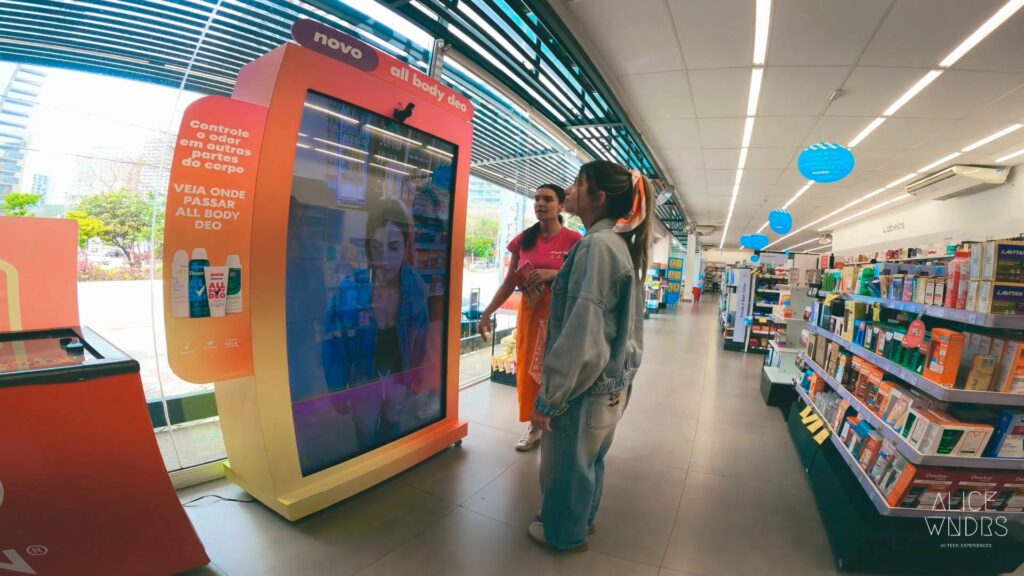
Point-of-sale technology has been transforming the way consumers relate to brands, products, and physical spaces. Today, investing in retail innovation is no longer just a competitive edge; it has become essential for creating more seamless, connected, and strategic experiences.
This behavior is also tied to the way the brain processes expectations and rewards. Consumers accustomed to fast, personalized digital experiences tend to develop a lower tolerance for friction, lines, and unintuitive processes in the physical environment.
That’s why integrating technology, convenience, and experience is no longer just a trend; it has become part of building journeys that align with today’s consumer habits.
However, amid the race for more modern and interactive experiences, many companies still make the same mistake: implementing tech solutions purely for visual impact or the “novelty effect,” without considering strategy, consumer behavior, and the real goals of the operation.
And this is precisely where point-of-sale technology stops being an advantage and starts creating noise, complexity, and even frustration along the shopping journey. In today’s retail, innovating doesn’t necessarily mean having the most sophisticated solution, but rather creating experiences that are more seamless, intelligent, and relevant.
When we talk about true innovation in brick-and-mortar retail, we’re talking about something that happens when technology, space, and experience work together to simplify the journey, strengthen the brand, and deliver measurable results.
In this landscape, concepts such as phygital retail, personalization, and data intelligence gain even more momentum, turning the point of sale into an increasingly strategic environment for shaping the retail customer experience.
So, in this article, you’ll learn how to choose, implement, and measure POS tech solutions strategically — going beyond the trend and focusing on what truly makes an impact for consumers and businesses.
The new role of technology at the point of sale
For many years, technology in physical stores was mainly associated with operational automation: payment systems, inventory control, and sales management. Today, however, the picture is different. Point-of-sale technology has taken on a central role in shaping the experience, influencing brand perception, relationships, and shopping behavior.
The point of sale is no longer just a transactional space; it has become an environment for connection, discovery, and experimentation. In this context, digital resources help make the journey more seamless, personalized, and aligned with the habits of today’s consumers.
More than digitizing processes, today’s retail seeks to create experiences that bring together convenience, sensory engagement, and data intelligence in a single space. The rise of e-commerce, social media, and apps has completely transformed consumer expectations of physical stores.
Today, people expect to find in the physical environment the same level of speed, personalization, and integration they get from digital channels. This behavior reinforces the concept of phygital retail, where the boundaries between online and offline become increasingly invisible.
When applied strategically, technology becomes almost invisible in the physical space, acting as an enabler of the journey and contributing directly to a better retail customer experience.
How to choose technologies that truly make sense for the POS
Choosing technologies that make sense at the point of sale may seem like a major challenge, but there are some extremely relevant factors that can help you select the ones best suited to your brand and your audience. Check out a few of them below:
Start with the pain point, not the tool
Before investing in any solution, the first step should be understanding which challenges need to be solved within the operation and the consumer journey. The most effective technology isn’t always the most sophisticated, but rather the one that responds to the business’s real needs.
Long lines, difficulty navigating the store, low conversion, little interaction with products, or lack of integration across channels are some examples of problems that can be solved with a well-structured point-of-sale technology strategy. When implementation starts from clear goals, innovation stops being merely aesthetic and starts delivering concrete impact on performance, brand perception, and experience.
Understanding the store’s context is essential
Not every solution works the same way across different retail formats. What makes sense for a flagship store may not be relevant in a compact mall store, for example. That’s why implementing point-of-sale technology should take into account factors such as:
- Foot traffic;
- Audience behavior;
- Brand proposition;
- Shopping journey;
- The role of that space within the omnichannel strategy.
In addition, the physical environment directly influences how technology will be perceived and used. Layout, visual merchandising, lighting, and spatial experience need to work together to create an intuitive and cohesive experience.
A useful experience is worth more than a “wow” experience
In practice, efficient experiences tend to generate more impact than purely tech-driven activations. That’s because the brain tends to respond more positively to journeys that are intuitive, simple, and require little cognitive effort.
Features such as self-checkout, smart fitting rooms, digital shelf labels, contextual QR codes, and integration between physical and digital inventory show how innovation in brick-and-mortar retail can be applied in a functional and strategic way. More than surprising people, technology needs to improve the experience in a way that is practical, natural, and relevant to the consumer.
The importance of integrating technology and operations
An effective tech experience depends not only on the tool chosen, but also on the operation’s ability to sustain it day to day. Staff training, systems integration, maintenance, and adapting internal processes are key factors in ensuring that technology truly contributes to the customer journey.
When poorly implemented, digital solutions can cause slowdowns, operational failures, and frustrations that directly impact the retail customer experience. That’s why innovation and operations need to go hand in hand.
Data and measurement: how to assess whether innovation is working
More than just collecting information, contemporary retail is beginning to evolve toward a Story Listening mindset — a concept built on actively listening to consumers through data, behavior, and interactions within the physical space.
In this context, POS technology is no longer just an operational tool. It now helps brands interpret browsing patterns, preferences, and the stimuli that shape the shopping journey.
For innovation to generate real value, it’s essential to track indicators that help measure the impact of the solutions implemented at the point of sale. Metrics such as:
- Dwell time;
- Foot traffic;
- Conversion rate;
- Average order value;
- Engagement and interaction.
All of these help determine whether a given technology is contributing to business goals. When it comes to POS technology, data-driven decisions are becoming increasingly important for optimizing investments and creating more efficient experiences.
In addition, sensors, heat maps, artificial intelligence, and analytics systems allow brands to better understand consumer behavior inside physical stores. This information helps optimize layout, product displays, visual communication, and even the shopper’s path through the space.
As a result, POS technology goes beyond operational support and becomes an important source of strategic intelligence for retail. In today’s retail landscape, innovation shouldn’t be treated as a static project, but as an ongoing process of learning and adaptation.
Running pilots, testing formats, and analyzing results before scaling solutions helps reduce risk and increase efficiency. This culture of experimentation is key to keeping pace with shifts in consumer behavior and building experiences that are better aligned with market demands.
Retail technology trends and the future of the POS
With technology constantly evolving, it’s only natural to expect new innovations to hit the market and directly impact the consumer’s shopping journey. That’s why staying on top of trends in this space and the future of in-store technology is essential.
Starting with artificial intelligence, which is already transforming personalization in brick-and-mortar retail, enabling more contextual, dynamic, and efficient experiences. Smart recommendations, automated customer service, and predictive analytics are just some of the applications expected to gain even more ground in the coming years.
Physical stores are also establishing themselves as strategic media and communication channels. Digital screens, contextual content, and targeted campaigns expand the possibilities for connecting brands and consumers at the point of sale.
The future of retail isn’t about separating physical and digital, but about creating increasingly seamless journeys between the two. In phygital retail, technology stops being an isolated element and becomes an almost invisible part of the experience, integrated into the consumer’s natural behavior.
Beyond the experience itself, technology is also set to play a bigger role in initiatives focused on operational efficiency and sustainability. Solutions that help reduce waste, optimize energy consumption, and improve resource management are likely to become increasingly strategic for contemporary retail.
Technology will keep transforming brick-and-mortar retail in the years ahead, but the real competitive edge will lie in how it’s applied. More than investing in trends, brands will need to create relevant experiences that connect with consumer behavior and align with business goals.
In the end, the best retail technology is the kind that improves the journey without stealing the spotlight from the experience. Because in the future of the POS, innovation won’t be measured by visual impact alone, but by its ability to generate connection, efficiency, and real value for consumers and brands alike.
Inscreva-se em nossa Newsletter
Receba no seu email todas as novidades do nosso blog sobre tecnologia e varejo, além de ficar por dentro do novos projetos Alice Wonders.
Thank you for subscribing.
Something went wrong.
Respeitamos sua privacidade e levamos a sério a sua proteção